
On the air with Leelanau’s radioheads
By F. Josephine Arrowood
Sun contributor
Despite rumors to the contrary in recent years, the medium of radio is alive and well. In Leelanau County, independent radioheads share their love of music, practice citizen journalism, and produce feature segments over the airwaves and online, on venues such as Interlochen Public Radio and college radio station WNMC. Here are some of their stories.
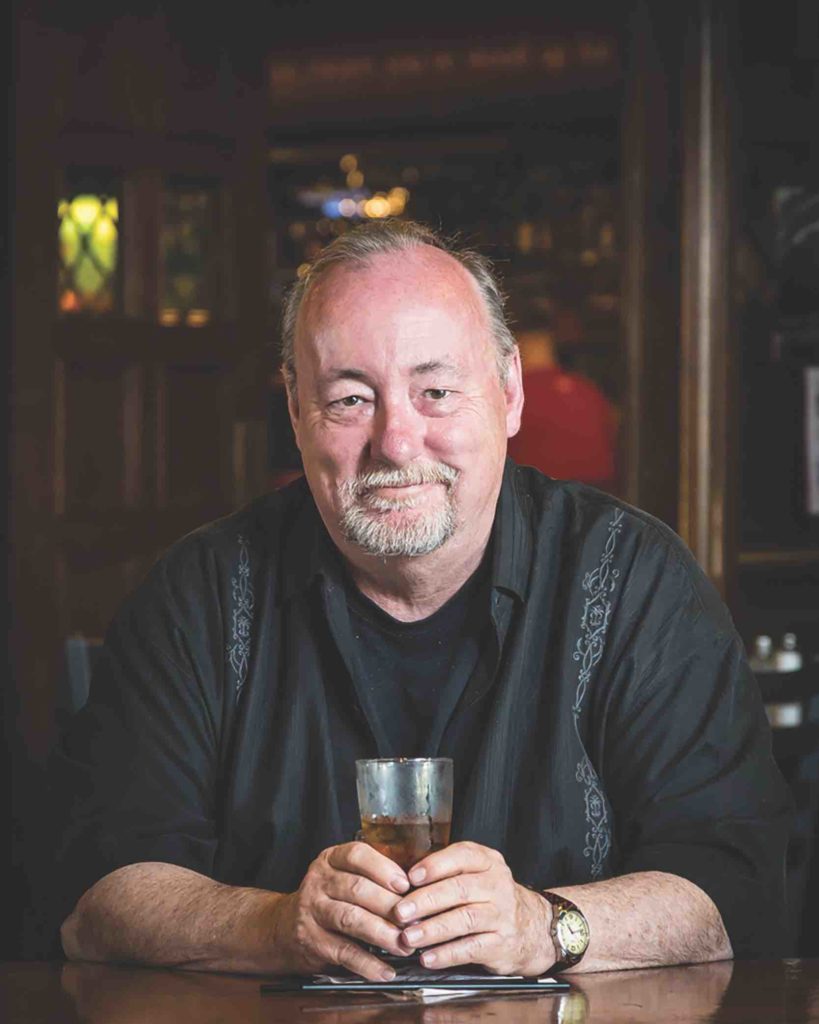
Ben Hamper: Before his memoir Rivethead startled, amused, and dismayed with its bare-knuckle account of life on the GM assembly line; before a cameo in Roger and Me; before writing for the Michigan Voice and Mother Jones, Ben Hamper was a dedicated radiohead. For 10 years (1981-91), the Flint native hosted a weekly show at WFBE that featured “a bunch of crazy bands and skits, basically a punk rock show. I’ve always loved music, collected that all my life,” he says.
When Hamper and his family moved to Leelanau in 1995, he discovered a community gem in WNMC, 90.7FM. It broadcasts 24/7 from Northwestern Michigan College in Traverse City under the guidance of freewheeling General Manager Eric Hines.
Their Facebook page states, “Founded in 1967 as a student activity available only to the NMC dorms and a few lucky folks close by, WNMC has grown into a radio station serving six counties and staffed by volunteers from all over the Traverse Bay area.”
In what may be his most delightful radio gig yet, Hamper is host and song spinner of two weekly shows on WNMC. Soul Possession began in 2006 as the successor to a prior DJ’s Friday night funk show. Over time, his weekly mellow audio fest began to gather speed and verve, and now features primarily rock—but not the ubiquitous Top Forty or overproduced pablum of commercial radio. His knowledge of the genre is extensive; his musical choices eclectic, even whimsical at times. A recent playlist included The Premiers’ “Get on the Plane,” Little Richard’s “Try Some of Me,” and “Mystery Man” by 1960s Flint band Dick Wagner & The Frost.
He says, “I try to keep it moving, hopping. It’s Friday night; people don’t want to hear a bunch of groovy ballads. They want fast-paced, high-octane rock’n’roll.”
Hamper’s voice projects comfort and ease, as though hosting a party at his own home. “That’s exactly what I attempt very time. I envision maybe six people I know being over; I drag out my new record purchases—a few friends over and some cocktails, keep everything loosey-goosey.”
He launched his second show, Head for the Hills, in 2010 after a friend turned him on to country music. “I was intrigued, then I got hooked; I couldn’t get enough of it. I asked [WNMC manager] Eric if they had anything like an old country show. I thought it would be perfect for Sunday morning.” Eventually a spot on the weekly schedule opened up from 10 to noon, and has proved even more popular than Soul Possession.
As a writer, he weaves a bit of narrative thread through his quirky, often obscure musical selections. “I’ll have a songwriter series. There’s birthdays, commemorations. I’ll have a truckers’ show. There’s plenty of woebegone drinking tunes in country; I’ll do a series called ‘Sinners and Suds.’ The [music] is primarily from the ‘50s and ‘60s, but there’s still people making good country music in the spirit of the old stuff.
“I get a kick out bringing illumination to these unknowns. I could sit there every week and play George Jones and Tammy Wynette, but I really try each show to pull out names from, like, the history of honky tonk—these people that fell through the cracks but had good records.”
When the pandemic shuttered the college campus in March, Hamper, like the other volunteer DJs, had to learn to prerecord shows at home. He uploads songs from his extensive collections and discoveries into a computer program, sending the playlist as an MP3 file to Hines in Traverse City. Hamper then records six “breaks” of sellbacks and conversational patter with a recording app on his cell phone. These are also emailed to Hines, who inserts them as indicated.
“You’d think it would be a lot easier. If you don’t like something, you can just stop and start over. But I try not to do that; I like to have the mistakes in there, ‘cause it’s real. It is very sterile compared to the studio, where I’d have ‘bed music’ behind me like a safety net; it loosens me up and makes it feel like I’m at a party.” Before COVID, listeners loved to phone in to his shows, like random guests dropping by. Currently, they connect with Hamper on FaceBook, leaving suggestions, requests, and feedback.
Another popular show feature was a live broadcast, typically on the last Sunday of the month. It started at the old Inside Out Gallery, then later at Union St. Station. This September, after a months-long hiatus, Hamper was invited to bring Head for the Hills to the Tru-Fit Trouser Building parking lot in Traverse City, complete with grilled food, potluck offerings, a Bloody Mary bar, and an actual audience—albeit masked up and socially distanced.
Hamper looks forward to WNMC’s long-planned move to new studio space at the Innovation Center, on the site of the college’s original West Hall. Heading into autumn, live venues remain uncertain—but despite everything, both Soul Possession and Head for the Hills will go on, he vows.
“I’m really proud to be associated with the station. I go downstate and spin the dial, and it’s horrible; there’s nothing that compares. The other day, someone asked me, ‘How long are you gonna do this?’ Until the day I die! As long as I can spit out the words and cue up the tunes, I’ll be doing it.”
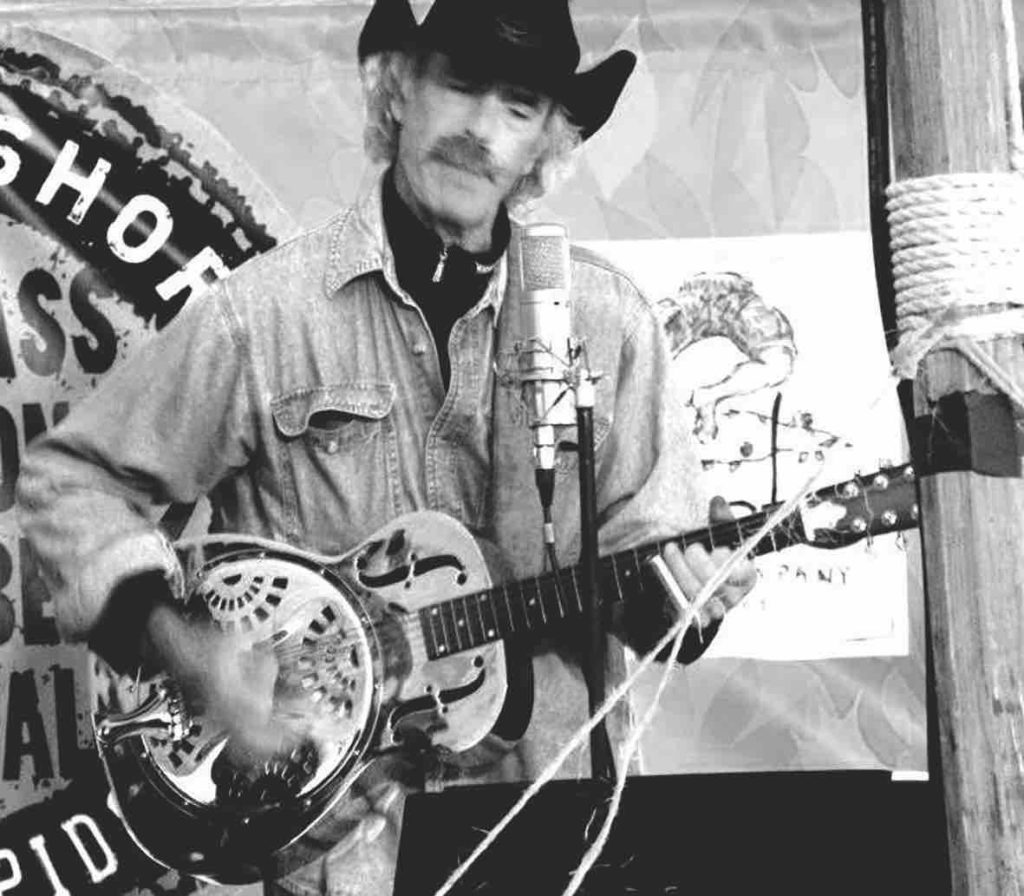
Sandy Blumenfeld of Elmwood is another longtime WNMC volunteer. Sandy B, as he is affectionately known, actually witnessed the birth of the radio station. “I was one of the first residents in 1963, when it wasn’t West Hall—it was the only dorm at the college. There were a couple of kids, radio freaks, putting out stuff over UHF—let’s just say it was pretty crude: mics in bathrooms, that kind of stuff—and people who lived on Front St started complaining about the TV interference,” he chuckles.
In 1967 the radio station was launched as a sanctioned “student activity,” to literally channel the activities of those early dorm innovators (college cofounder and benefactor Lester M. Biederman had also created Traverse City’s first commercial radio station, WTCM, in 1941).
The 1960s folk revival movement, with Dylan, Baez, Mitchell, and others, influenced the Northern Michigan scene, as did the blues. “Out at Holiday Hills, they had ‘hootenannies’ on Sunday nights—basically, they were open mics. We’d go to that a lot. One of my suitemates in the dorm was a good finger picker. I played ukulele and four-string; he got me started playing six-string guitar. Some local kids, like Tom O’Brien, hung out at the dorms, and we all played music.
“I grew up with music in Keego Harbor, near Pontiac. We had a baby grand piano; my dad played uke, my sister played guitar. In college, I’d go down to Detroit to the Chess Mate, where Chuck and Joni Mitchell were the house band; they were like the Seth Bernard and May Erlewine of that day. They had Tom Rush, Ramblin’ Jack Elliott, Eric Anderson, David Blue.”
While Blumenfeld’s musical education was expanding, his college studies suffered, and he eventually left school. He married, had a family, and worked as a stone mason for years. He’s always played music with others in the community—Patrick Niemisto, Geno Miller, Bob DeKorne, Jonah Powell, to name a few—but it was when he retired, around 2004, that he unearthed his musical NMC roots in a new way.
“The DJ thing was totally different. My wife worked for a local doctor, whose husband Bob Brown did stuff for WNMC. Bob said they needed more help at the station. I sat in on his Crossroads show a few times [Americana, blues, folk], and then did my own Crossroads.”
He recalls with amazement the breadth and depth of WNMC’s archives, and manager Eric Hines’ generosity to the quirks of volunteers. “There’s a format, for sure, and a genre, but the fact that we could play what we wanted” was a key attraction. “I was blown away by artists I’d never heard of. The longer I’ve stayed there, the more I realize I don’t know s—!”
The longer he stayed, the more fun he had—so much so that he took on a second show, Local Motion, which highlighted music from the Northern MI scene, and eventually cohosted an early morning drive-time slot as well. Along with his band mate Bill Dungjen of Sour Mash, he also frequented Round Up, a weekly open mic show at the Hayloft Inn on M-72 that was broadcast for years on WNMC.
Recently, he’s cut back a bit—turning Local Motion over to a couple of other DJs after a dozen or so years—and the pandemic’s restrictions have caused more advance planning than he likes, such as prerecording shows and cohosting drive-time slots over the phone. The downside of returning to the radio station will be cleaning mics, quarantining CDs played, and bad weather commutes. But he feels it’s all worth it to get back to his well-polished seat at the soundboard, headphones on and big boom mic at the fore.
“I like to work spontaneously and without a lot of preparation,” he laughs. “Hopefully, we’ll be back in the studio soon!”
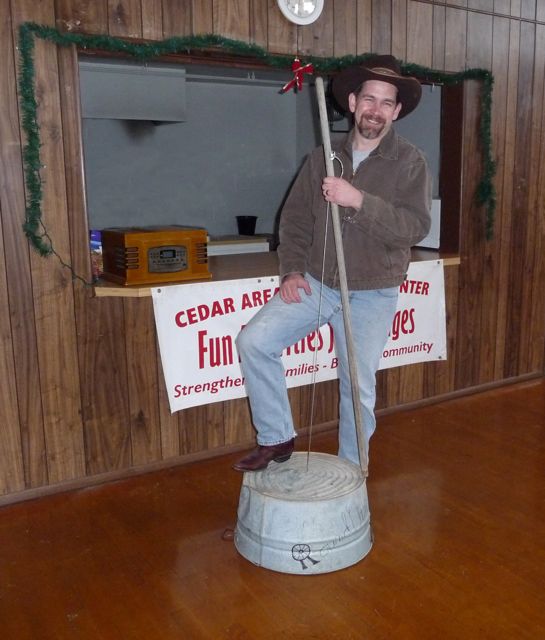
Bill Dungjen of Cedar has taken a different path to radio. A theater veteran of Old Town Playhouse and other live drama, the bluegrass musician was the long-time host and organizer of Round Up from 2004 to early 2020. The talent variety show evolved from a regular open mic at the Cedar Tavern. he ran it for a while, but when the tavern stopped doing open mic nights, he approached Hayloft Inn owner Marion Peplinski—and the rest is history.
At some point, Dungjen began to record each week’s Thursday night show, edit, and condense it into an hour-long episode that ran on Sunday nights on WNMC.
“It was born out of live performance, but without the time to rehearse,” he explains. “We were looking for something to make open mic more fun, give it a little pizzazz. It was really kind of cool. We had a lot of people drop in: locals and traveling musicians like Bobby Yang. Michael on Fire, The Accidentals, Joe West. Merle Haggard’s illegitimate son Scott showed up, played some tunes. Billy Strings came. He wasn’t famous then—he wasn’t even old enough to drink. We’d read the dispatch blotter from the Leelanau Enterprise. People would say, ‘You can’t put that on the radio!’ But we did.”
Round Up led to another radio opportunity for Dungjen when WCCW in Traverse City hired him to put together a weekly, hour-long polka show that ran from 2008-2011.
“That channel was ESPN for 23 hours a day on Saturdays, except for the polka show at 7AM,” he says. “Who knew there are so many polka bands out there? They came out the yinyang! People would call in all the time. Cute little old Polish ladies would leave voicemails, and I’d bump ‘em right from my cell phone [into the show]. It was my weirdest gig. One show, I played two 30-minute polkas.”
In 2014, he produced six shows for Interlochen Public Radio as well, a kind of touring Round Up that included venues such as the venerable Elderly Instruments shop in Lansing and Cherry Republic in Glen Arbor. “Jonah Powell and I did all the editing for the first one. What Jonah did was refine my messes.
“Doing it for free, I always went for open-source stuff; I use Audacity [editing software] almost exclusively. It’s a comfort level thing; it’s so much fun. And there have been many tech changes over the years,” he says. He has so many audio adapters, he could hang them on the wall, like a visual timeline honing his craft at his studio, Cedar Valley Productions.
Currently, Dungjen directs theater productions at Glen Lake School, but this year, the pandemic has served up an ironic, yet appropriate twist. “I just got green-lit to put on a radio play,” he chortles. He’s already dreaming and planning: “A Christmas Carol, with sound cues, incidental music. There’s enough mics to space the kids apart. We’ll go as high fidelity as we can. We’ll have fun with it!”

Larry Mawby is having fun with radio these days, too. The pioneering Suttons Bay winemaker retired last year, and joined Red Pine Radio, a group of Northern MI independent amateur producers. The group was created by Peter Payette, Interlochen Public Radio’s executive director, to facilitate stories unique to the region. Anyone interested in telling audio stories can join. IPR hosts workshops periodically, and Red Piners meet once a month (currently via Zoom) to pitch stories for Points North, learn technical skills, and foster camaraderie.
Mawby says, “I find it really intriguing. You have an idea of what the story is to begin with, and then being willing to throw that out. I don’t want to be in the story. If I do, then I’m editorializing. I really try to just set the scene and let it roll smoothly, naturally. Or let two or three experts talk—let them carry the story along. I still shape [it].
“For the past several months, myself and two others worked on a series about what’s going on in the natural world. [With COVID-19], it seems really appropriate. How does nature talk? Wind is generally considered a defect in audio. There’s waves, animals, a bird cry. Then things that are not auditory: the color of a leaf, topography. So you want people who are enthused, excited about what they talk about: brook trout, the larval hatch. You’re telling a story without pictures; now you’ve provided a little bit of an image.”
He’s learned to help people get comfortable with the interview process, “so they can feel free to present themselves. If they have a filter, it becomes a challenge to say what they feel. What I hope an interview does is get the gist of it. My technique is to ask the naïve question—then you’ll find out.”
He uses his cellphone to record conversations with an app that saves them as mp3 audio files, and likes a Tascam to record ambient sounds, and Hindenburg Journalist editing software.
“One thing I’ve noticed since COVID is the accepted quality of video and audio [in general] has declined. I really like the raw, unfinished; there’s a sense of reality. The most enlightening thing about this? How long it takes! Listening, marking, cut and paste—a 20-minute phone call will yield maybe 15-20 seconds” of material.
“Anybody can do this,” Mawby says. “My interest is really in helping people to be heard, to tell their story. Red Pine, through IPR, makes it a two-way communication.”
To get in touch with local radio resources, visit www.interlochenpublicradio.org/programs/red-pine-radio or www.wnmc.org/join/volunteer.htm


