Nancy Gallagher and the Death Café
By F. Josephine Arrowood
Sun contributor
Nancy Gallagher was once a certified nurse-midwife, joyfully ushering new life into the world. Then she spent 14 years as a hospice nurse, helping people to prepare for life’s final journey. These days, the Suttons Bay resident feels called to serve as a volunteer death guide: dedicated to making sure people don’t die alone; supporting their families; showing them how to have a green burial; or knowing the legal requirements of funeral home directors. Thus was born Death Café Grand Traverse.
“How it started for me was, I had been in midwifery. Then at some point, they closed the midwifery service, and I thought, I really want to do hospice. That was about 20 years ago. I went into that through Munson [Medical Center], and during that time, my father went into hospice. It was a sad time; it was a hard time because I was really close to my dad. But it was a rich, beautiful time—because we had it, and we were very real with each other, and it was really nice. Yes, it was hard, and it was the first real family member besides my grandparents who had died. Then a couple years later, my mom—who had been a halo nurse herself—she died in two weeks after a broken leg was followed by a lung infection. I just remember thinking, ‘This isn’t happening, is it?’
“But my parents, when they were in their 50s, [had] told me and my siblings, ‘If we die tomorrow, we have no regrets; we wouldn’t do anything differently. We know you love us, and we love you.’ That was it. So if something happens, it’s really hard, but it’s gonna happen, no matter when it happens.”
A photograph of herself with her four older brothers hangs over her mantle, taken about two years ago at a nephew’s wedding. “The one on the far left, we hadn’t seen him in a while. I decided I wanted to toast the couple, to bring my parents into the discussion; my nephew had known his grandparents very well. So I said that thing: ‘If we die tomorrow . . . .’ And six months later, my brother takes his life. All the preparation, all the study— of end of life ‘normal,’ end of life ‘abnormal,’ the grief, all of it—has helped because he knew I loved him, and I knew he loved me.”
Nancy began facilitating Death Café six years ago in the Leelanau-Traverse City area. The global movement was started by England’s Jon Underwood in 2011, and inspired by Bernard Crettaz, a Swiss who had created Café Mortal. Social worker Lizzy Miles brought Death Café to the United States. Anyone can start a Death Café in their community, using the Guide on deathcafe.com. Locally, the Grand Traverse-Leelanau group, and a Benzie County group facilitated by Betty Demers, are active.
“As a hospice nurse, [we] decided that people weren’t necessarily prepared when they came to hospice—and that’s only a small proportion of people who are dying, anyway.”
“Being with people who are dying is not the hard part,” she adds. “But nobody wants to talk about it. I knew a woman who died this summer, suddenly. She was in her forties. She was a person I could share and be authentic with, and that’s what Death Café is all about: bring real with people about this topic that nobody wants to talk about—but everybodywants to talk about.”
I ask, “How do you even have conversations about it? A lot of times, you’re not even the next of kin; you’re not the one that everyone is consoling and saying, ‘Sorry about your loss.’ But you feel it—the death of an acquaintance, a former spouse, your daughter’s best friend from school.” I wonder how I’d react if I was told I would die. Wait, I think. It’s not if—it’s when. We don’t even want to have this conversation with ourselves, it seems. But as the saying goes, nobody gets out of here alive.
“Anytime you have a new loss, it pokes into other losses you’ve had: the death of parents, a brother, even our pets. It’s better to work through it,” she says.
I mention that several people I knew have died recently and I’m struggling with it. She emphasizes that the Café is not a traditional grief counseling support group. “It’s not intended to change people’s point of view or even make them more comfortable with the idea of death.” She then invites me to experience an upcoming Café event.
A few days later, I arrive at Sara’s home in Elmwood Township. There, guests help themselves to tea and slices of cake created by Nancy; a Death Café tradition, she says, started by its English founders. Many of today’s nearly two dozen attendees greet each other as familiar friends, while several of us are new. As expected of Leelanau County’s aging demographic, most of the group are elders, with a few of us in midlife. At age 57, I may be the youngest present. But as Nancy points out, death comes to everyone, at any age, and in all ways. A line from the Leonard Cohen song “Who By Fire” comes to mind: “And who shall I say is calling?”
We gather comfortable chairs into a circle, and Nancy, acting as facilitator, gives a brief overview of Death Café. It’s about creating a safe, supportive place, “to talk about death without an agenda, without experts, without program or content … we are humbled by the notion of leaving our credentials at the door and getting out of the way of the conversation rather than controlling it.”
We all look through diverse lenses at death and the dying process. We’re all trying to catch a glimpse, a hint, guidelines for grappling with this final mystery or “the great equalizer,” as Nancy puts it. We go around the circle and briefly introduce ourselves. Several people say that they started coming to Death Café out of curiosity, and have returned because they find meaning in the conversation and community. A comfortable silence, like collective breath slowly exhaled, envelops the room for a moment. Then, the Café discussion gets underway.
David says, “They say death is the opposite of life. But death is not the opposite of life; birth is the opposite. Death is a part of life. I found that to be very helpful.”
Ed, a widower in his nineties, asks if others have information about green burial. Where can they legally be buried, and which funeral directors in the area are supportive? Can they refuse to be embalmed—and by the way, how long can such a body stay unburied or uncremated?
Julia shares that she has already arranged for her own burial: “I plan to die at home, and be buried on my land. I’ve got my ducks in a row.” She sounds both determined and cheerful, in control of her leave-taking itinerary. She shrugs as she acknowledges that she may not even be at home on the fateful day, as she continues to live a very full life in her early nineties.
The conversation lightens for a moment, as a woman mentions a much-treasured book, Love, Loss, and What I Wore, which prompts another thread about possessions that have outlived their purpose. She says, “I seem to be thinking more about letting [stuff] go. And I’d want my family to know.”
Another woman recalls feeling “grief at the things we have to let go of. When I had to sell off my looms, each one was a loss.” Her voice reveals that letting go is an ongoing journey, with uneven steps that stride and falter in turn. She adds, “I’m tired of the death phobia. We don’t have to die in fear, but in love.”
Jan says, “I’ve experienced a lot of death,” of her spouse, a child, and others. “I thought I knew what to do. But now my friend is dying; what’s coming up for her at this stage of the game is emotional baggage. I had no idea about big parts of who she is. Guilt, resentment, anger, regrets—these things are coming out now for her. I’m realizing how important it is to have these things resolved.”
John agrees. He speaks of the value of counseling or other therapy, even about losses from earlier times, to address “garbage that needs to be thrown away.”
He also values the importance of community and conversation about dying and death. Several family members had died over the decades, but, “No one talked about it; it was not discussed in any way. When my wife died several years ago, we had a lot of help from hospice, our church. But our culture has virtually nothing to support death. We’re creating a local culture that’s filling that gap—I’m so grateful to the people here who are spearheading that.”
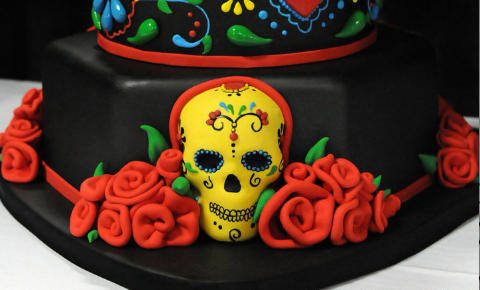
Across the room, Fred relates that the Jewish high holidays begin on Sunday, September 29 with the New Year or Rosh Hashanah. “Then eight days thinking about atonement, asking for forgiveness, and then fasting for twenty-four hours on Yom Kippur.” Sally mentions the Mexican tradition of El Dia de los Muertos, when families visit cemeteries to honor and celebrate their dead; and someone else recommends the movie Coco: “I went with my grandkids, and we were able to talk about death, and family.” Nancy speaks about keeping an altar in one’s home, irrespective of religious practices, as a way to remember loved ones and mark the passage of time.
The Fall 2019 issue (#91) of Yes!Magazine is passed around, thumbed through; the entire theme is “How to Have a Good Death.” Fred announces a workshop that he plans to hold in mid-November at the Traverse City Senior Center, on “The Box, or The Final File.” Someone suggests a program on green burial, separate from the regular Death Café meetings.
Each perspective, each nugget is greeted with nods of recognition, or questions, or sharing of an insight. Everybody is welcome to speak or be silent, as they wish. Someone asks, “Am I talking too much?” No, no, she is reassured. This is all good, all part of the respectful interchange that creates and sustains the communicants of today’s Death Café.
After nearly two hours of sharing, people spontaneously seem to realize that the meeting is over for today. We scrape back chairs, gather bags, fly out the door on a quick goodbye, or linger for a few more moments of conversation. Then it’s back into the stream of life, with its schedules, projects, and challenges. We have things to do, people to see. Death’s Café has served its purpose, helping us to make the most of our finite time here. After all, we are all fully alive, today, right now—until we die.
For more information, find Death Café Grand Traverse or Death Café Leelanau on Facebook, or visit www.deathcafe.com.