
Michigan: The Land of Plenty
 By Norm Wheeler
Sun editor
Some of my relatives west of Shelby, in Oceana County, recently had a yard sale, and my mother, Anna Jean Wheeler, scored an old book there about Michigan that used to belong to my grandfather, Neil Wheeler. Neil grew up on a farm east of Hart. His sister Emma had polio, so he carried her on his back quite a distance to their country school. (She later attended college, became an attorney, and practiced law in Washington, D.C.)
Neil Wheeler walked the country roads as a young man selling life insurance to farmer’s wives. (“What if that mule he’s plowing with kicks old Hiram and kills him — what are you gonna do then?”) He later had an insurance and real estate office along with my father, Robert Wheeler, in downtown Shelby, and Neil spent two years as a member of the Michigan legislature. I still have the old swivel chair and the spittoon he brought back from Lansing when his two-year term was over (he didn’t seek re-election).
He loved Oceana County, loved driving the country roads, and he could tell you who owned every farm and acre. Neil Wheeler was one of the founders of the Shelby State Bank, and he was one of the first people to drill for oil along the shore of Lake Michigan (just south of the Little Point Sauble lighthouse, the westernmost point of the lower peninsula).
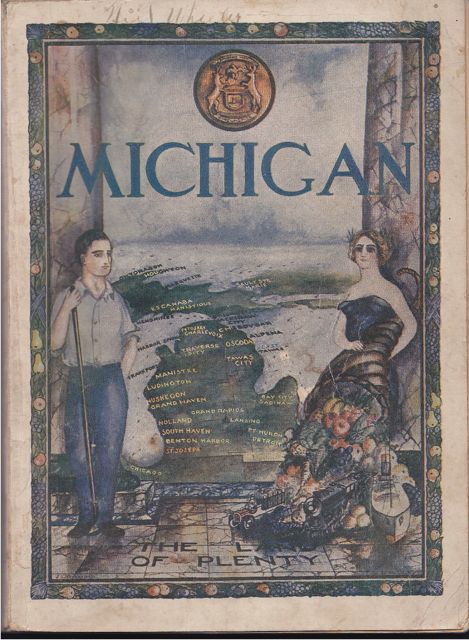
This old paperbound book entitled Michigan: The Land of Plenty, was published by the Public Domain Commission and Immigration Commission in June 1914, to promote the Agricultural, Horticultural and Industrial Advantages of the state. In the Forward, Mr. Augustus C. Carton, Commissioner of Immigration, and Glen R. Munshaw, Deputy Commissioner of Immigration, write that it is their duty to:
“collect and compile information relative to the advantages and opportunities afforded by this state to the farmer; the merchant; the manufacturer; the home and pleasure seeker; and to distribute the information. First, to stimulate Michigan’s own people to a deeper appreciation of the state in which they live and to encourage a greater degree of agricultural development by calling their attention to the opportunities and possibilities afforded by their home state, and Second, to encourage the settlement upon Michigan’s agricultural lands by people from the neighboring states and Canada, and by intelligent rural immigrants from Central and Northern Europe. Michigan invites inspection and need make no extravagant claims to establish the fact that it offers to the farmer, the homeseeker and manufacturer opportunities unsurpassed by any other state in the Union.”
(… intelligent rural immigrants from Central and Northern Europe!)
A brief history of the state’s early development follows, and then many great black & white pictures show lakes, rivers, homesteads, summer cottages, long stringers of trout, and the campuses of the University in Ann Arbor, the Agricultural College in East Lansing, the College of Mines in Houghton, and the Normal Schools in Marquette, Mt. Pleasant, Ypsilanti and Kalamazoo. Following many pages about the physiography, soils and minerals in the state, and the agricultural opportunities, there are short summaries about each county. Here is what the book says about Leelanau County:
“Leelanau County was laid out in 1840 and was organized in 1863. The name — according to an Indian legend — means “Delight of Life.” The total land area of the county is 220,233.58 acres, of which about 160,000 acres are in good farms. The population is 10,608 (1910 census). The valuation of taxable property as estimated by the State Board of Tax Commissioners in 1911 is $6,388,512. There are 61 schools, supplying positions for 84 teachers, and an enrollment of 2,385 students. The county has 5 banks and 3 weekly newspapers, also telegraph, telephone and rural mail service. Leland is the county seat and has a population of about 400. It is located at the mouth of Leelanau river, the outlet of Lake Leelanau, on the west shore of the peninsula forming Leelanau county, 25 miles northwest of Traverse City, and 4.5 north of Provemont, its nearest railroad point. There are Lutheran and Methodist churches, and a weekly newspaper is published. Leland has become popular as an ideal summer resort. Empire, the largest town in the county, has about 650 inhabitants. It is located on the shore of Lake Michigan and on the Manistee and Northeastern Railroad, 28 miles southwest of Leland and about the same distance from Traverse City. It has Catholic and Methodist churches, a bank and a weekly newspaper. Other towns of the county are Northport, (pop. 600), and Suttons Bay, (pop. 600).
(Lots of interesting history books full of old tales of Leelanau County and of Michigan can also be found at the Leelanau Historical Museum in Leland (231-256-7475) and the Empire Area Museum (231-326-5568 or 231-326-5519). Call for fall hours.)
The late poet Max Ellison — founder of the Stone Circle near Elk Rapids — sums it up in his poem:
Michigan My Michigan
He spread a bolt of pineland beneath a canopy of blue,
Then appliquéd the rivers with his hand.
He mixed a dream with a vision for a host of pioneers
Who had started out to settle on the land.
He took the thunder from the mountains, the west wind from the plains,
The glory from the sunset, and it’s true,
He blended in the music the pine tree always sings when it’s summer
And the wind is passing through.
He hollowed out some valleys, spread some mirrors down for lakes,
Mixed some iron and some copper with the sand.
But he couldn’t call it Eden, he had used that name before,
Then an Indian whispered:
“Call it Mich-i-gan, Mich-i-gan, Michigan!”
