Leelanau Conservancy holds Native Plant Rescue
By Sandra Serra Bradshaw
Sun contributor
In a field filled with roses and lilies, I am a wildflower swaying with the wind. I look at the butterflies befriending the pretty flowers with a tinge of blush on my cheeks. I wonder about the secrets exchanged between them. -Vinitha Dileep
Leelanau County is well-known for its population of earth-caring individuals among its members, and those that care for wildflowers and native growing plants are no exception. The Leelanau Conservancy, the county’s land preservation group, started its wildflower/native plant rescue program in the fall of 1999. Its singular purpose is to save native plants, keeping them from bulldozers and from other sources of destruction.
The Conservancy summons volunteers for its annual kick-off at the Old Art Building in Leland on Wednesday, April 15 starting at 10:30 a.m. “The Wildflower Rescue Committee is calling your name,” the Conservancy writes on Facebook. “From digging and potting, to helping at the sale, there’s a place for you. We’re also looking for new rescue sites this season. Come learn, connect, and get involved—then meet us in the woods this spring!”
The annual plant sale on Leland Village Green in Leland is Friday, May 22 and Saturday, May 23. The sale begins at 9 am each day. Expect to find lots of beautiful Leelanau wildflowers for your own garden and do go early as many plants sell out quickly.
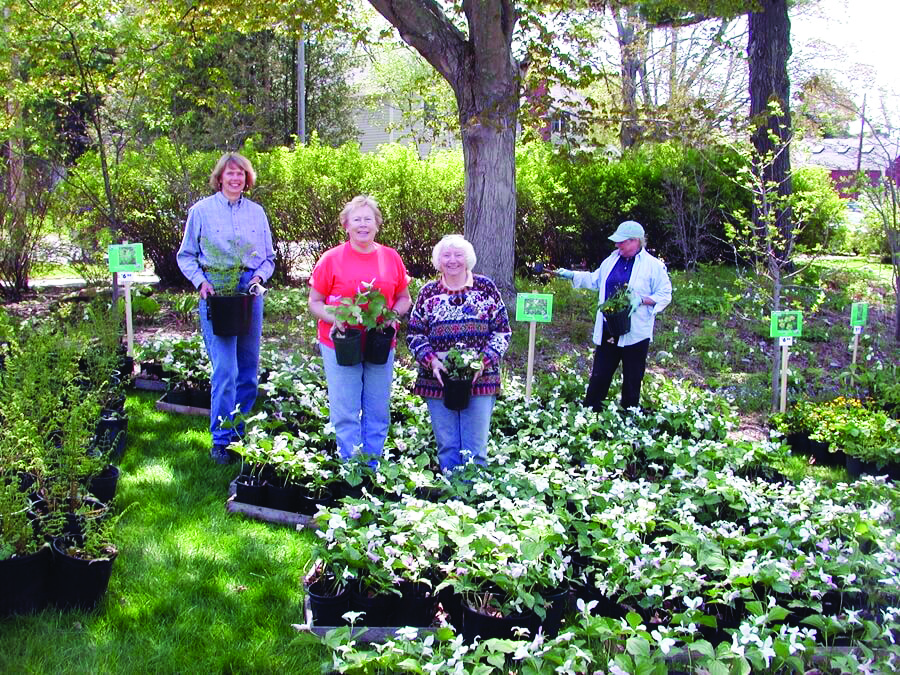
Each spring, as delicate wildflowers begin to blanket the forest floor, dedicated volunteers head into the Northwoods on a mission: to rescue native plants before they’re lost to development. They visit forested sites before roads are constructed along with future driveways before they’re paved and build sites before they’re dug. And all along, they search for plants at risk of destruction. These delicate ephemerals are dug up at just the right time, as they emerge so quickly and so quickly fade off. The plants removed from harm’s way, carefully re-potted, and given new homes at the annual plant sale.
Then, in May, gardening volunteers will delight in finding lots of beautiful Leelanau wildflowers, like trillium and jack-in-the pulpit and other native plants. On the day of a dig, they meet at 9:15 am at Leland Village Green for location assignments from the committee members. Digs are tentatively scheduled for Monday, Wednesday & Fridays between April 25-May 20, and of course, weather dependent.
“Our Wildflower Rescue program is one of those efforts that really connects people to conservation in a hands-on way,” said Brighid Driscoll, communications director at the Conservancy. “When a development site is cleared, native plants that took decades to establish can disappear in an afternoon, and that’s a loss that’s hard to recover from,” she said.
“We’re always on the lookout for dig sites where wildflowers and other native species are at risk of being bulldozed. If someone knows of a site, a new construction project, or a land clearing, please, we want to hear about it. Every rescue is a chance to preserve a piece of Leelanau’s natural world and give those plants a future.”
The wildflower rescue focuses primarily on the woodland or shade plants that are found in our hardwood forests.
“Any plants protected by Michigan Law are legally dug with permission of the property owner,” said Driscoll. “We do not dig rare or endangered plants, and all plants are inspected by the State Ag Dept. for disease. We go into a site before the roads are constructed, the driveway is built, or building site dug, and we take the plants.”
It’s important to note that the property owner’s wishes are respected and plants that will not be destroyed are left on site intact. The wildflower volunteers dig in the spring and fall, which are the best times for the survival of these mostly delicate plants. The group usually digs on Monday, Wednesday, and Friday in the morning, for about an hour each session. If need be, they can work around equipment and work demands as deemed necessary. The conservancy always goes as a group and only after receiving a signed permission agreement with the property owner. This releases the owner from any liability.
Many of these lovingly rescued plants have been donated to public gardens such as the Old Settlers Park in Glen Arbor, the Leland Children’s Center, the Old Art Building in Leland, Munson Hospice House in Traverse City, and the Leland Village Green. The rest of the plants are potted and sold to raise money for the on-going maintenance of the Leland Village Green.
The Leland Village Green, located in the village of Leland on Main Street, is across from the Leland Post Office. Originally this now restored piece of property was once the parking for the Manitou Island Ferries that departs from nearby Fishtown to the Manitou Islands. When the land was offered for sale, there was a proposal to erect a hotel. Next, Mr. and Mrs. Hugh Smith, who eventually purchased the parcel, had considered developing the property into a shopping complex of perhaps 20-30 shops. Concern was expressed by the community that the peaceful atmosphere of Leland was being eroded by “injudicious development.”
The New York Times in August 1988 remarked on the rapid commercial changes taking place in this quiet Great Lakes village. The Times wrote;[Most days, by late in the morning Leland, a 100-year-old eyeblink of a place nestled between ”the little lake” (18-mile-long Lake Leelanau) and the big one (Lake Michigan), is usually awash in visitors, many arriving in cars, others pouring off tour buses, a sea of pastels and baggy shorts, autofocus cameras in hand.]
At this time, the Leelanau Conservancy, which had been recently founded by Mr. and Mrs. Ed Collins of Leland in 1988, approached Mr. Smith. He was sympathetic to the idea of preserving the land as green space and offered to sell the land along with two adjacent parcels totaling one acre to the Leelanau Conservancy. This at the cost of only his investment and Mr. Smith kindly allowing time for the conservancy to raise the necessary funds. An intensive fund-raising campaign was immediately initiated and donations received enabled the purchase of the property for $460,000.
The Leelanau Conservancy finalized the purchase and preserved this, its first green sanctuary, in 1990. Many supporters and community members far and wide contributed toward the purchase of the property and then through the years further enhancement and maintenance of this special sense of community place.
A must-have book to aid in identification is the book Michigan Wildflowers by Harry Lund, first published in 1991, by Northmont Publishing, features 278 beautiful full-color photographs along with information about plants and flowers in Michigan. The book also features a wildflower quiz and a guide to eight of Michigan’s most accessible and diverse wildflower trails.
If you would like to get involved with Wildflower Rescue, please contact the Leelanau Conservancy office: 231-256-9665 or email Lindy Kellogg, Events and Volunteer Manager at lkellogg@leelanauconservancy.org.