
Isadore’s latest secret: Vissers’ organic farm
 By Pat Stinson
Sun contributor
It’s barely June, and the sweet red pepper plants (“Carmen” variety) carefully tended by Matt and Carissa Visser in their Isadore Farm greenhouse north of Cedar are 18 inches tall, thick with blossoms, and ready for sale to gardeners digging in the fresh, spring earth.
While others may plant a vegetable garden to feed their households or raise flowers to brighten their yards and scent their rooms, the Vissers have another mission in mind.
On approximately one-and-a-half acres (so far) of their 12 1/2 acre certified organic farm, the couple is growing healthy food and a building a new life within the local food community.
“We really love food and going to farmers’ markets,” Matt says, explaining some of their reasons for choosing a farming lifestyle. He added that they also “sensed a national shift” or growing awareness among the general public of foods and food safety.
In spring and early summer, they offer greens such as kale and arugula and herbs, including cilantro, to local food markets. They also sell specialty crops they love — like broccoli raab (a.k.a. rabe or rapini), treviso (a mildly bitter Italian lettuce and type of radicchio), and green garlic (regular garlic harvested early for its onion-like bulb and edible, pungent leaves) — at local farmers’ markets. Lesser-known but no less flavorful foods will also be sold to area restaurants, whose chefs have already placed orders for delicacies like salsify (pronounced “sal-si-fee,” a.k.a. “oyster plant”) used in French cooking.
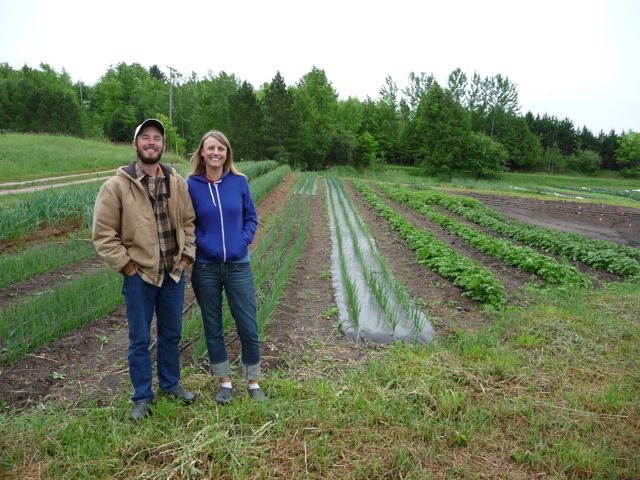 This year, the pair will have planted 74 common and specialty vegetable varieties (including 12 of tomatoes, 15 of garlic), herbs and flowers as part of a plan to see what grows and also sells. (A complete list is available on their web site, www.isadorefarm.com) By working for a year at the successful Meadowlark and Sweeter Song farms, Carissa has learned what the soil in this climate can yield, with luck and the right ingredients.
Moving laterally along the 45th
The Michigan natives, (she’s from Grand Rapids, he’s from Lowell to the east of Grand Rapids), received their bachelor degrees from the University of Oregon and made their home for several years in Eugene, located at the southernmost region of the Willamette Valley. There, they fell in love with the food community and way of life, and enjoyed growing their own food in a “huge garden” that satisfied their then-vegetarian diet.
The Valley is known as the state’s agricultural heart and wine-growing region, and the two immersed themselves in the region’s considerable foodie culture. Carissa, a goldsmith, took a class in urban farming and worked at Sundance Natural Foods, where she developed an appreciation for great, local produce and local food security, and learned even more at annual conferences hosted by the Provender Alliance (and educational outreach and networking nonprofit for natural foods’ stores). Matt, a mycologist and self-employed indoor air-quality consultant, had grown up helping his parents with their roadside stand and was the grandson of farmers who worked the land in Iowa and Minnesota before retiring to Michigan.
Their idea to return to Michigan sprang from a desire to be near family. And, as Matt explains, “In Michigan we felt ahead of the curve, that we were getting in on a local trend. In Oregon, I felt like we were a decade too late.” Or, as Carissa puts it, “There was a saturation (of organic farmers).” They sensed that Traverse City was the only place in Michigan with the Valley’s vision of food and a similar food community.
Establishing connections
Matt and Carissa’s inspiration to become organic farmers developed from several sources. Among them were (and are) the books and teachings of Steve Solomon, founder of the Territorial Seed Company and one of the organizers of the nonprofit organic certification and educational organization called Oregon Tilth. Matt says Solomon has greatly influenced how they think about things. (For more information about the entrepreneur-gardener, visit www.soilandhealth.org.) Both say that as newcomers to the area with a new farm, they needed to build trust and establish relationships with customers, including commercial accounts, and that certifying their organic farm would give strangers a level of confidence in their food. As their web site states: “It’s your assurance that we are serious about taking care of both your health and the health of our environment.”
Isadore Farm on Gatzke Road continues farming traditions on a portion of land previously owned by the Miller family, (Mrs. Miller still lives next store and relatives own property nearby). The Millers moved to Isadore from Germany in the 1940s and grew potatoes, green beans and cucumbers before raising cattle in the ’80s. The Vissers named their farm for the community at Gatzke and Schomberg roads, then discovered the happy coincidence that St. Isidore is the patron saint of farming.
Last year, Carissa and her mother farmed, (Carissa’s mom is responsible for the beautiful flowers they sell), while Matt and the dads built the couple’s one-and-a-half story, energy-efficient home at the base of a steep hill with a summit view of Sugar Loaf mountain and the surrounding countryside. Matt and friends also tackled the challenge of reconstructing a used greenhouse purchased without assembly instructions. Family and farmer friends — such as Reed Johnston of Second Spring Farm (on Hoxie Road near Bugai) with whom they share equipment, time and help — have kept them going when there was barely enough time for swimming, one of their favorite warm-weather activities.
In summer, the two say they’re in the field by 6:30 a.m. and stop working at sunset.
So when do they rest? Last winter found them “mostly sleeping.” During what Carissa calls their “hibernation,” they planned seed orders, reapplied for organic certification, worked on “infrastructure” (planning/digging a root cellar and making spinners for drying lettuce), and also found time to visit family on weekends and to cross-country ski.
As the 2010 market season begins, Carissa says: “The whole thing’s a leap of faith. It’s been encouraging so far.” As for their goal of being self-employed and developing a sustainable lifestyle, Matt, who still does consulting work, says: “We definitely won’t be rich, but we’ll be well fed.”
The Vissers can be found at farmers markets in Glen Arbor, Suttons Bay and Traverse City. Select produce is also carried by Oryana Natural Foods and Wellington Street Market in Traverse City.