“Imagination writes the rules” with musician Luke Woltanski

By F. Josephine Arrowood
Sun contributor
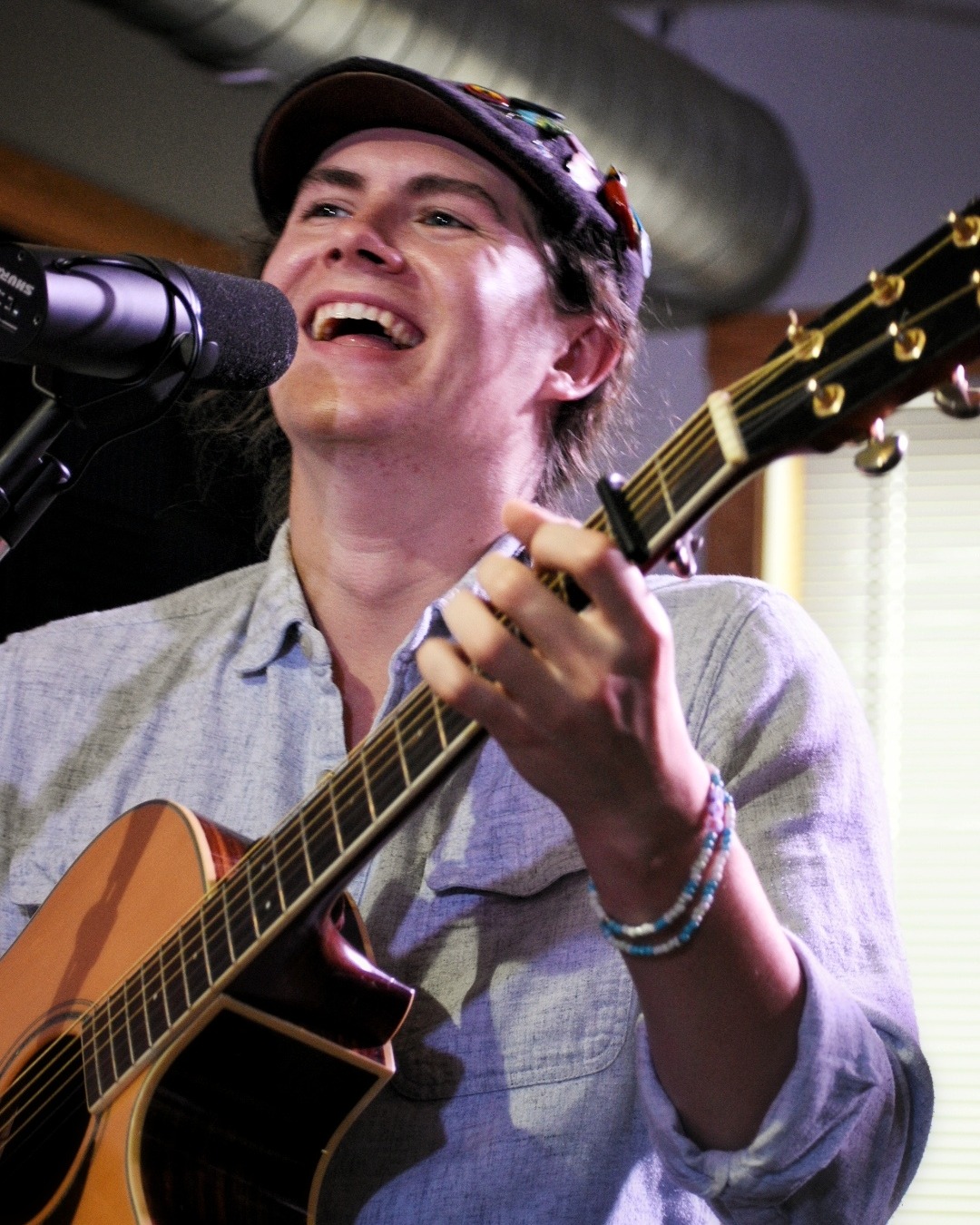
At the age of 18, musician Luke Woltanski has attained several significant accomplishments: Named one of Plainwell High School’s “Top 16 of 2016,” the Allegan County native and seasonal Glen Arbor resident graduated this spring with a 4.0 grade point average; was a National Honor Society member; Academic All-State varsity swimmer; and member of the internationally renowned Kalamazoo Children’s Chorus. He heads to Hillsdale College this fall, with plans to major in pre-med and possibly minor in musical theater. Oh, and in his theoretical spare time, he has created three albums of original alternative folk music, with a fourth in progress — on which he sings and plays a wide variety of instruments — that he recorded and mastered himself, and now sells through the Glen Lake Artists Gallery, iTunes, cdbaby.com, Amazon and Spotify.
He sat down to chat at the Leelanau Coffee Roasting Company (LCR) after a long shift working as a barista.
“We’ve been coming up north ever since I was about five,” he says, to the family cottage near Little Glen Lake, and the northern skies and landscapes feature prominently in his songs. His second album, Fog Dance: An Instrumental Collection, features beautifully rendered tunes such as “Sleeping Bear,” “Fallen Star”, and “North Winds.”
Luke doesn’t know where his talents came from, but it doesn’t actually matter. He’s got them, and behind his warm, buoyant personality, his curiosity, passion, and tenacity drive him to explore the seemingly endless possibilities of music making. Learning new instruments, song writing, and producing work to share with others takes a lot of time and energy, but because he’s so immersed in his creative process, he makes it seem effortless. As he writes in “Life on the Double Planet,” from his most recent album, Constellation, “Imagination writes the rules and laws, and they all do just what you say.”
He credits a former high school vocal music teacher, Keith Cahoon, with encouraging his early musical promise. “Mr. Cahoon was a legend in our area. He was hierarchical, a top choir kind of director. After he retired, we found a choir director from Chicago, Denise Beauchamp. When Mrs. Beauchamp came in, she tried to level the play so anyone could join. They were the people who told me, ‘If you’re going to do music, don’t do it half-way.’ They also gave me the idea that, ‘You might be better than all right.’
Talking to the youthful musician, it immediately becomes apparent that he doesn’t do anything by halves. And he still has a few items on his bucket list.
“I was lucky enough to be in the high school musicals each year; I got to be in Crazy for You and Joseph and the Amazing Technicolor Dream Coat; Reverend Shaw Moore in Footloose; and the Scarecrow in the Wizard of Oz.”
His face lights up as he recalls a song, “Ship of Souls,” he played at a high school concert, ”It crashes and burns; a section of the song goes into a beat, then it starts stacking up … We got 800 audience members going, got them all riled up. In Plainwell, the concerts draw people from all around. I do the art openings at the Center Gallery on Friday nights in Glen Arbor. Sometimes people will sit down and listen. That’s on my bucket list: to be able to do a concert with a lot of people.”
When he writes a song, what goes into it? “A lot of people write personal songs; there are a lot of love songs, for instance. Not mine,” he laughs. He titled one song ‘Illuminati’ because, he explains, “All the lights were flickering on and off while we were playing.” He credits two high school friends and fellow musicians, Abby Ernst and Luke Sienko, on his most recent album, Constellation.
“Ship of Souls” from that CD was inspired by his dad’s love of Bruce Springsteen, and a serendipitous find at a garage sale.
“Springsteen plays a lot of harmonica, but where do I get one of those?” He stumbled upon a Hohner Weekender, which has double holes with pairs of reeds for a rich tremolo sound, akin to that of a 12-string guitar (which he also plays).
His first instrument was regular acoustic guitar, which he started learning in fifth grade. “In sixth grade, Mom and Dad got me a mahogany dreadnought; I spent a couple of years with that before I graduated to the resonator. I didn’t really know how to play the guitar at first; I’d just play.” His parents suggested he check out music by Credence Clearwater Revival and Gordon Lightfoot to study some popular music structure.
Some of Luke’s own musical inspirations include Michael Hedges, Bruce Hornsby, Bonnie Raitt, and Seal.
“Michael Hedges changed solo guitar from something that was played in backgrounds in dark areas, to something that was extremely engaging, and almost more exciting than normal music. Bruce Hornsby was able to fuse the skill needed for jazz piano with faster tempos of ’80s rock ballads, and his sound is something that is impossible to forget. Now, Bonnie Raitt is very interesting, because she plays very slow progressions on her guitar, but she uses a slide and the whammy bar on her guitar to make the note change and morph into something that becomes its own little universe in just one sound. Seal, he has a fantastic voice, and his music is just fun to listen to! He also makes use of the 3rd in chords, and he likes to play with the 3rd and the 4th in his music, and it just sounds really cool!
“Gordon Lightfoot, too, I suppose, just because I like to write in his style: the kind of story that you had around a campfire! ‘New Horizon’ was the first song I ever wrote six years ago. Now I think it was pretty terrible, but I then thought, why not? Mr. Cahoon, my music teacher, said, ‘Well, your music’s great, but it’s unprofessional.’ That kind of killed me! He had me learn Don McLean’s ‘Starry Night.’
Other experiences included being selected for the state’s High School Regional Honors Choir, and the Kalamazoo Children’s Chorus’s elite Touring Choir, which toured Italy in the summer of 2013.
“Fred Sang is the director. Everything had to be just perfect — really good — and it just moved me along. After we got back from Italy, I wrote ‘Summertime Minstrel,’” which appears on Luke’s first album, Prairiefire. “The next spring, they asked me to perform it at the KCC spring concert. I did it on my 12-string Guild dreadnought.”
To play a 12-string, he explains that he has to “think in two planes: low set and high set. I have to think — so your notes are exactly in tune and pitch … The low notes of the guitar are almost like a lyre or dulcimer; it’s a very full sound, like a whole band. After the KCC concert — I was 13-14 at the time — some people told me afterward, ‘You’re how old?’ One elderly woman in the front of the audience bellowed out this tremendous, ‘Wow!’” He grins at the memory.
Where does he think his musical gifts came from? Neither of his parents plays an instrument or sings, but he says his great-great-grandfather played the piano, and his 15-year-old brother Seth, who also works at LCR in the summer, is developing as a singer.
At the coffee shop, he has finished his shift and gone home to the family cabin on Little Glen Lake to get a few of his instruments. These include the harmonica, an Indian flute, and his resonator guitar, its spun metal cone replacing a traditional acoustic guitar soundboard for added volume.
Why the resonator? He explains that almost everyone uses a regular wood guitar, while the resonator is often played in the blues and slide guitar styles. “It’s got a really funky sound: metallic, so crisp and clean. With the harmonics, I barely have to tap it.”
He’s been practicing a song, “Spectrum,” for his next album. “It starts really slow, then speeds up and slows again, and ends in a fury of harmonics and bars,” he says. “If I’m thinking about it, I can’t do it.” He tries it again, demonstrating how he fingerpicks while using the same hand as a percussive aid at the base of the neck and along the metal frets, a technique known as slap, or slapping and popping.
When he’s at home, or recording solo, he uses another percussion instrument called a porch board bass. “It’s basically a big metal bar across a bubble. The harder you tap it with your foot, the lower it hits. So, going with the beat, I can play it all: harmonica, porch board, guitar. You can hear it on ‘Summertime Minstrel,’ ‘Runaway,’ some others.
Luke pulls out a wooden Native American flute he acquired while still a young boy. According to his understanding, it’s a courting instrument from “back when the Chippewa were in charge. Every single flute is in a different key, and if a man wanted to marry someone, he’d have to go up to their place and play a song. If she didn’t like it, her grandfather would drag him off the porch, and he wouldn’t get to marry her.”
He plays a melody on the instrument, but no one in the coffee shop tries to drag him out. Heads turn, people sit up a bit straighter, and smiles light up faces. After he’s done with his song, he gestures with the flute and says, “With this, I found out I could do all kinds of things.” And the coffee shop patrons — now impromptu audience members — would heartily agree.