
How to Love a Lake
 By Holly Wren Spaulding
Sun contributor
I walk beside Lake Michigan in every season, and in almost every weather, though it’s loveliest in summer, with bare feet, everything sparkling: the Manitou Islands, the sculptural driftwood. Most days I go to Good Harbor near Pyramid Point, but some days it’s Port Oneida, or even as far south as Esch Road or Elberta Beach. I look out at all that clear blue water and think “how lucky are we to have this lake?”
Photo by Keenan May
Oil has gushed all over the Gulf of Mexico for months now and I don’t try to shake those images of non-stop destruction because a gigantic portion of apathy and looking away is the reason these disasters happen. Still, I look long at the majestic lake I love and pray that it will always be good and lovely in the summer sun, the winter winds. I walk north or south with my dog Lucy, both of us wet around the ankles, the breeze on our faces, sand in our hair.
At some point I dive in and swim, the wet cool like a home, my own body inside in this larger, shifting, body. I float on my back, blinking up at the sky, drifting further into the glittering deep. I dive down. I touch the rocks. I get out and see the carp where they rot on the shore. I walk over the sharp layers of broken zebra mussels. I wonder about the green algae that muddles the shore. I see the birds that have died from botulism. It’s all interconnected, complicated, suffering, alive.
These watery walks are a daily act of love, but also a devotion. I consider it a political act to go there; to acknowledge what gives us the life we have, to pay attention, bear witness, love what is precious and elsewhere, too scarce. I walk to bear witness and to make a kind of internal, emotional record of this lake and my life with it.
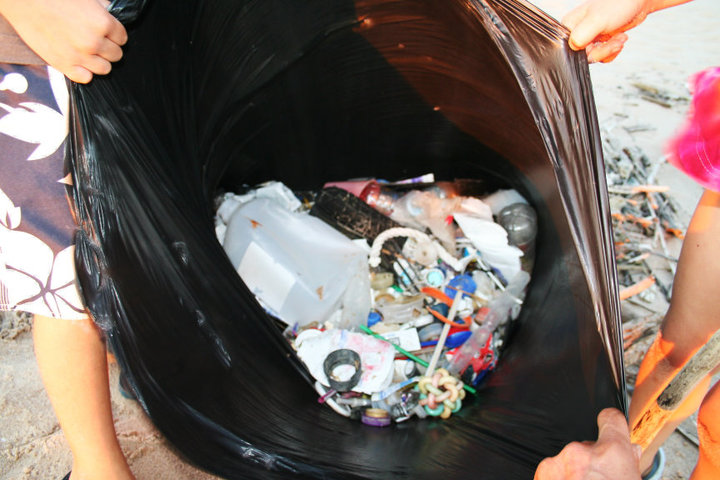
Photo by Tim Volas
Big storms bring waves — my surfer friends rejoice — and also the remains and waste from other places, or from our own hard-to-break ways. A week or so ago friends in Benzie started seeing trash and medical waste washing up at Otter Creek beach. The next day they brought their kids, several old buckets, and started gathering up the great snarls of debris. It’s an ugly sight, these artifacts of 21st century living: black plastic comb embossed with the words “Milwaukee County Club”; used syringes, baby blue plastic hair pieces.
The local writer Stephanie Mills told me she makes a habit of clearing trash from the roadways near her home in Kasson Township so that “the creatures don’t have to contend with it.” I appreciate this sensibility and have tried to do the same where I live. The “don’t litter” mantras of the 1980s tried to sell America on the aesthetics of trash-free public spaces but it matters more that the heron, plover and deer are faced with all of this detritus in our common landscape. Some of them don’t know it’s lethal. We may not realize this ourselves.
At this time of year we are accustomed to seeing people enjoying the lake. We swim, sail, canoe, surf, and watch the sun go down from all of the west facing beaches. Are we not all water-worshippers? I fear that we are not. If we were, we’d be more outraged than we are to hear that oil from the recent Kalamazoo River spill will make it’s way to Lake Michigan, and in the meantime, strangle everything in it’s path. We’d also be a happier, a less stressed-out bunch, if we would just get out of cars, walk out of our air-conditioned buildings and down to the lake a little more often.
I take some consolation in this ritual of the season. So much about our lives is otherwise predicated on economic activity, as in, we spend our days and nights trying to make the money, and attending to our so-called adult responsibilities. During what remains of our time we tend to be consumers, pursuing our needs, following our desires. It is for this reason, I believe, that many of us long for greater satisfaction in our daily lives.
The American philosopher, Henry Bugbee, wrote about how immersion in place can evoke wonder. He wrote, “The world does not become less ‘unknown’ in proportion to the increase of our knowledge about it … Our experience of the world involves us in a mystery which can be intelligible to us only as a mystery. The more we experience things in depth, the more we participate in a mystery intelligible to us only as such.” It is a deeply moral act to know a place — one’s home, for instance — and to foster affection, generosity, hospitality and protectiveness toward that place. It is also good to not-really-know, and yet deeply sense, something like a lake; to submit to the mystery for the pure joy of it. It is important to understand the ecosystem as the marine biologists do, and useful to measure lake temperatures, and note the effect that climate change has on this habitat. It is also of valuable to fall in love, to do so over and over again, and to maintain that relationship with the fierceness we defend the other things that give us nourishment, meaning, and purpose.
When I was a teenager I studied with the writer and river-lover, Michael Delp. We read poems, essays and stories that made the case for a wild mind, a wild heart. Daily, he raged against that which separates us from the greater world around us — blind faith, consumerism, intellectualism ignorant of the physical world — and he also made us read things that reinforced this sensibility. It was in a poem by Jim Harrison that I found one of the wisdoms that has stuck with me since, a sort of mantra: “We don’t get back those days we don’t caress, don’t make love.” Life is short and it’s in our hands to treat our time here like something precious; to treat the place itself as a heaven, here, and now. If I were less certain of death, I could stay at work or at home, docile at my desk.
What does any of this have to do with the lake and how to love it? Mary Oliver, another early influence, wrote “Whoever you are, no matter how lonely, the world offers itself to your imagination, calls to you like the wild geese, harsh and exciting — over and over announcing your place in the family of things.” Which makes me wonder: what is our place in the family of things? What is mine? I walk and know that it makes me more alert in this world, perceptive by degrees, curious at the wild presence of all that is out there: the smashing waves, raptor call, blue blue sky, and the otters with their feast of fish. The trash on the beach. The oil on the waves — not here, exactly — but everywhere, because no part of this world, is apart, is not connected to the rest.
A couple of nights ago I was out late with some friends. We’d been dancing, riding our fleet of bikes around Traverse City at 3 a.m. In time we landed at the harbor and all 10 of us tore our clothes off and ran, splashing into the dark water. You’ll look a long time before you find so many people that free, that full of delight, in Traverse City at the end of the tourist season. I dare you. The way to love a lake is to jump in. Often.
Holly Wren Spaulding is a poet and writer from Cedar.