
Far from home: a soldier remembers America’s “Forever War”
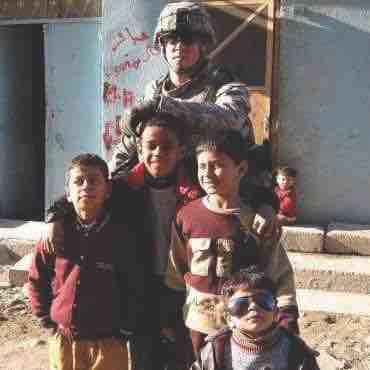
Beadleston poses with local children during his deployment to Iraq in early 2009, less than a year after serving in Afghanistan.
By Nick Beadleston
Sun contributor
If it had been a movie, the explosion would have come near the end. We’re taught to believe there’s a natural crescendo to stories. A predictable arc and a satisfying conclusion. And for some, the explosion did come at the very end.
An Afghan laborer who would never again walk through his front door. Hoisting his small daughter aloft, feeling the weariness of the road replaced by the warmth and safety of home.
An American soldier who would never return to the neighborhood of his youth, sick of the wide world and ready to finally begin a family of his own. He would never work at his uncle’s timber framing business, learning, in time, to run it after his uncle was gone. He would not die of old age surrounded by generations.
Those chapters will never be written. Their stories, like many others that day, and many thousands since, ended abruptly.
The explosion which destroyed these lives used to be a man. Maybe he was from the surrounding countryside. Or possibly he, too, had traveled far from his home. I never found out what exactly his suicide vest was made of. If it was like the others I would see later, it must have been bulky. But this he could easily have hid under his thick winter coat. Most likely it was rudimentary in design. Homemade. Fashioned from common materials. Old nails or ball bearings from a rusty can in the workshop corner. Maybe they had come from abandoned farm equipment. Purchased by foreign aid to till the unforgiving soil for crops the land would never abide.
Maybe he used wires from the local hardware store. Did he smile at the clerk as he purchased them? Did he wish peace and blessings upon him and his family, as was proper and customary?
What did he think as he twisted the wires and carefully added the material which would eventually spread him across several hundred meters? And farther still, he may have believed, to paradise.
Did he feel dread? Pride? Destiny?
Maybe he had an ailing mother they said they would look after once he’d done his duty. Maybe he felt nothing but hatred and the seductive joy of retribution.
Or perhaps the bomb was in his cooking stove.
These were commonly used as improvised explosive devices. They were ubiquitous and came with a ready-made accelerant. A practical choice for martyrs.
Maybe the weapon used that day was made by a woman’s nimble fingers. Retasked from picking pomegranates and poppies or sewing torn chapans for her husband or father. These days, Jihad isn’t just a man’s calling.
We heard later that the Vice President had been visiting Bagram and had been the intended target. But the sheer size of the air base made that virtually impossible. It was a series of walls within walls. Miles of checkpoints and gun towers and reinforced concrete. Stone skin atop a skeleton of rebar.
Much more probable was that the suicide bomber had been sent to test the strength and readiness of the incoming American division. That’s when these things normally happen. During the transition between one unit and the next. There is a natural chaos, and complacency is high.
The 10th Mountain soldiers who were killed were scheduled to leave in a few days. We had barely been there long enough to unpack our rucks and unfurl our guideons, emblazoned with telltale double A’s of the 82nd Airborne.
I feel compelled to state here that I was never a very good soldier. For those who know me now, this doesn’t come as a great surprise. I was undisciplined and disrespectful, bordering on insolent. I made sarcastic remarks and engaged in practical jokes, knowing full well the result would be exhausting hours undesirable duties. Or getting “smoked,” grueling physical activities designed to curtail misbehavior. In my case, this often meant lunges with the barrel of a 50 cal slung across my back. And, of course, I deserved what I got.
(A staff sergeant once wrote in a report that had I been in any other nation’s army I’d have been justifiably executed. Even now the thought of his exasperated face makes me smile.)
I rarely refer to myself as a soldier or a veteran, choosing instead to say “my time in the Army.” I hold the soldiering profession in high regard and dislike sullying it with my short-lived stint in uniform. But deploy I did, and serve I have. For that, I am proud.
I struggle to recall the events of that mid-morning in February, and much of the year that followed at the foot of the mountains. Many times since, an unexpected sound or scent will cause me to remember. The smell of diesel exhaust on a cold winter day. Or stale sweat. Not the fresh musk of heavy exertion, but layered order of exhaustion.
Memories beget memories. But never in a straight line. Bursts of recollection. Often humorous. Sometimes melancholy.
When the memory of that day arises unbidden and unprepared for, I force it back down. I bargain with myself that one day I will sit with it. Examine it. Replay it again and again. Allow myself to recall it fully. However, today is not the day I always tell myself. But soon.
And then another year goes by.
Many of the details of that day have dissolved, like grains of sugar settled to the bottom in a cup of dark tea. The warm liquid has stained them brown with the passage of time. Other memories crowd them out now. Some real, like those of my time in Baghdad which would follow. Some imagined; the conflation of images seen in the media and the fictitious depictions of events on the screen.
What I do remember is how bright the day was. It was cold, too. But a thick, standard issue sweater under fatigue under a protective vest, or IBA (short for Interceptor Ballistic Assembly), and kevlar helmet took care of that.
And besides, I had the voluntary excitement of an exotic new territory to warm my soul. I had never seen mountains, true mountains. The distant peeks of the Hindu Kush were instantly, and will forever will be, burned into my mind. Imposing and glorious.
There was so much energy and excitement. Up Armored humvees and MWRAPs rushing past. Mammoth C-5s thundering down and MH-6 “little birds” taking to the air.
Companies of South Korean soldiers jogging in perfect unison. Aussies and Kiwis, almost indistinguishable to our uninitiated eyes, strolling along, rifles slung nonchalantly on their backs.
Despite having been trained as a cavalry scout, schooled in land nav, radio operations, and small arms, I would spend much of that deployment on guard duty atop the walls of the United States’ largest airbase. Not unlike a young Roman up on Hadrian’s wall (except I had a Zune, the short-lived forerunner to the iPod). We were holding the line against the barbarians, and defending the territory within from almost certain defilement.
At that point in the war we were standing sentry for the sake of imperial pride rather than the preservation of democracy. But that wasn’t something most of us would understand until years later.
These long and generally uneventful stints were occasionally and mercifully punctuated with patrols into the local neighborhoods and markets of Bagram. As a kid of the suburbs, I had only ever seen meat already butchered and packaged for convenience. Unrecognizable as the animal it had been. Quite a shock to see skinned goats, eyes and all, hanging from hooks in the stalls. The butcher would hack off a piece with precision, package it in yellowing newspaper, drop it into a colorful plastic bag, and hand it to an eagerly waiting woman. All the while he hummed, at peace with his work.
The entire scene was wonderful and cacophonous. A perfect picture of messy and boisterous humanity. Vendors yelling. Women gossiping. Vehicles honking. Tinny music blaring from cheap speakers. So much life. Ever since, I have loved a good bazaar or farmers market, feeling cheated by the safe and controlled nature of indoor grocery stores.
When not relegated to a guard tower, endlessly scanning the horizon, I was down in “Lanes.” This half mile long stretch of roadblocks and checkpoints served as the main point of entry into the base for vehicles and foot traffic. There were countless semi-trucks laden with supplies and endless lines of haggered workers coming and going at all hours.
We worked closely with a corp of Afghans deputized to help coalition forces with vehicle and personal searches. We gave them all American nicknames, usually based on whatever American celebrity they most reminded us of. A small taste of home and a convenient excuse not to fully learn their difficult names.
Sensing the irony of this, I asked them to give me an Afghan name. To them I became “Rashid.”
But this would come later.
A squad of us were headed to our new duty station in Lanes when we heard the explosion. We were so green that we initially mistook the sound for a blown semi tire (as we were warned occasionally happened with these lumbering metal behemoths which should have been retired decades ago). I remember seeing something shoot high up above the wall. At the time I thought it was the remains of the tire. I now know it was the remains of a human.
Vehicles began to race past us. Alarms blared and voices barked commands over our handheld iCom radios. I had been trained for combat—though in truth I only thought I knew what that meant. This was something else. There was no pitched battle. There was no return fire. There was only a single deathly blow. And the gory aftermath.
We ran toward where the explosion had come from.
The human body holds much more blood and excrement than you’d expect. And the viscous nature of blood means it isn’t quickly absorbed into the soil like water. It just pools there. Dark, dark crimson at first, slowly browning in the sun.
There were bodies, maybe a dozen. And there were countless pieces of what had been bodies. Pink like uncooked meat. They looked ready to be scooped up by the butcher and neatly packaged in his stall. Steam rose from the still warm flesh into the cold winter air.
After the area was secured, it was my job to stand guard over a group of truck drivers who were being searched when the bomb went off. Uncertainty prevailed throughout the entire situation. For all I knew one of these men was an accomplice. We had been trained to look out for a second suicide bomber. Sometime these were even more substantial than the first. It was their intention to kill any military first responders and civilians who rushed in to help after the first blast.
I’ll never forget the scene which followed. It remains the most darkly humorous thing I have ever witnessed. It is the solemn duty of the military’s mortuary affairs workers to catalogue and collect any piece of human remains much larger than a quarter. (I have often wondered how many interred remains of U.S. service members are mixed with those of Afghans who happened to be standing nearby.) As these dedicated workers performed their duty, the drivers I was guarding began to call to them and point to any remains which had been missed. In their pragmatic way, they were endeavoring to be helpful and to show that they meant no ill will. The absurdity of this act moved me to laughter. It rolled from me in waves. Deep and uncontrollable, like vomit.
There are so many things about that year in Afghanistan I’ve forgotten. Like the name of the boy who befriended me. After learning I loved potatoes, he once proudly brought me a dish of potatoes his mother prepared. I still taste them.
I still see his face on occasion. Sometimes it is the bright and smiling visage of youth, just like it was. Sometimes it is dark and creased, twisted by cruelness. Now the face of a seasoned Taliban fighter. Sometimes it is black and swollen, his mouth filled with flies.
No matter how hard I try I cannot remember his name. I am moved now to tears. They roll uncontrolled down my face and stain the pages of my notes. But I cannot remember his name.
As these words, these memories, flow for the first time onto the page, I know countless Afghans are flowing from their homeland. Like blood pouring from a million wounds. They are fleeing by plane, and by car, and by secret mountain trails, routes passed down from their father’s father.
Tajiks and Pashtuns. The Hazaras. The Aimaq. The Baloch. The wealthy and the poor. The secular and the pious. An exodus of biblical proportions. A humanitarian crisis unrivaled in this new century. And it is only the beginning.
I can’t fathom what it means to be a refugee. To leave everything. Not just what you own, but what you’ve built. Everything you’ve ever known. To move without warning or choice to a new and foreign land. A land where the trees have different and difficult names. Where the soil smells unfamiliar after the rain. Where even the saffron tastes different—off, somehow.
What is it like when you can’t even find the right ingredients to make the dishes which brought you comfort as a child?
Though challenging in so many ways, my deployments were finite in length. I always believed eventually I will return home. And I have.
Also, I was there with others. Friends. Comrades. Those who understood. Who could help bear the hardship. Who could share the pain and carry the burdens alongside me.
I am often moved to frustration by my fellow country men and women who have not served in some capacity. Where were you when we were standing guard in the mountains, and fighting in the deserts, and being blown apart in the streets?
Where was your patriotism and your pride then?
Your democratic fervor and your love of liberty?
But that time, and much of that anger, has passed.
Right now, today, there is an incredible opportunity before us. Before every American. Before everyone who believes in peace, and equality, and the values of our founding doctrines.
We each have a fresh chance to embrace those many Afghans fleeing tyranny and certain destruction.
We can open our homes. And if not that, then our wallets. And if not that, then our pantries and our closets. And if not that, then we can write letters, and make calls to those in power.
This is who we are. It’s the bedrock of our traditions. It’s in our nature. Our bones. Our cells. Our DNA. We are giving people. And now, more than ever, is the time to manifest that generous spirit.
Over the past 20 years, so, so many stories have ended abruptly. Tragically. In loss, and pain, and lingering sorrow.
Now, we have a chance to write a new chapter in the lives of thousands and thousands of stories. In our own story. The one that defines and unites us. The one that will be retold and will endure long after our part has ended.
What will we choose to write?
Nick Beadleston, 33, served in Afghanistan in 2007-08 and Iraq in 2009. He lives today in Traverse City, where he is executive director of Commonplace. Beadleston was recently named to The Traverse City Business News’’40 Under 40. He encourages readers to support the fundraiser, “Standing by Afghan Families Who’ve Stood By Us.”

