
Empire’s Gnarly Old Man

George Tweddle and son, David, in their Empire ginseng garden. Photo courtesy of Empire Area Museum
By Pat Stinson
Sun contributor
All the farmers drove Mercedes,
the occasional BMW,
and all that they were farmin’
was a mere hectare or two.
What in heaven’s name
could be the source of all this wealth?
It’s just a funny, gnarled root
that some folks nibble for their health.
And they call it
You can hear the cash registers ringin’
Ginseng, ginseng
All the wealth it could be bringin’.
Across the wide Pacific,
in China far away,
a billion folks think it’s terrific.
They eat it every day.
From the song “Ginseng” ©1995, Alex Sinclair.
Used by permission.
They sleep in the shade of maples, poplars and oaks, their parents’ aged, yellow heads nodding above them. In October, a stiff breeze or squirrel’s impatience knocked their berry-red cradle to the ground. Now, they wait for a blanket of decaying leaves to cover them, so the earth’s moist breath can force new sprouts from their tiny husks. Two springs will pass before they emerge from their leaf layer and slowly grow a single leaf of their own, while sending down a root that can grow to eight inches in length and thicken and twist for more than 50 years, if left in peace.
These roots belong to ginseng (Panax quinquefolis) prized by Asians for centuries for their purported herbal healing properties. The older the root, the more beneficial it’s said to be, whether sipped as tea, eaten in slices or popped as pills.
Ginseng grows wild in this area, as it does it many parts of Michigan. Long winters and mature forests satisfy the plant’s requirement for months of dormancy and shade. Before the turn of the last century, fur companies and others discovered that the aromatic roots could be dried and sold for a handsome sum. They dug as many as they could, until lumbermen stole the shade that the plants needed to survive. Foragers then searched under young trees, and the number of ginseng stalkers grew as its popularity and price increased.
Today, the plant is protected by the Michigan Ginseng Act of 1994 that declared the once-abundant Michigan “Man Root” a threatened species and, thus, illegal to harvest. The Michigan Department of Natural Resources Wildlife Management Division strictly enforces the law with close monitoring and collaboration with other agencies. Stings in coastal areas downstate have reportedly occurred in the last decade, and poachers continue to wander not only wild woods but also private land in search of ginseng, wild or cultivated. Those who cultivate the herb legally for personal use will hardly admit to it, as a result.
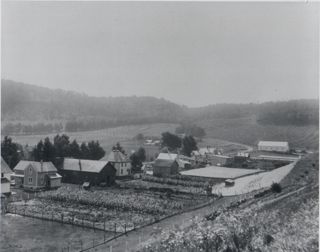 Fradds made their backyard beds.
In his 1976 story, “The Legend of the Ginseng Plant and the Wilderness” (in Some Other Day (Remembering Empire), Empire Area Heritage Group, 1987) one-time Empire resident Frank S. Fradd told of building beds for ginseng in the family’s backyard in 1913. He and his dad fashioned a six-foot tall wooden canopy (of “lath”) above the beds to provide shade plus a bit more sunlight than would naturally occur in the forest to speed the growing process. Seeds and roots for the beds were harvested from the woods. Father and son grew the plants for “six or seven years,” but the seeds took too long to produce good-sized roots, and they were heavier and fetched a smaller price on the market. It was a short-lived experiment. The son, Frank, went back to harvesting wild ginseng, sold it to help support himself during the Depression, and hunted it for a total of 30 years.
Made in the shade
Only three large commercial growers in the state are currently certified (inspected and licensed) to sell ginseng, according to John Hill, ginseng project manager for the Michigan Department of Agriculture (MDA). Two growers cultivate and manage under artificial shade, which produces a more carrot-like root (fewer twists) in three years and brings far less on the market. The other, Great Lakes Wild Woodland Ginseng, uses the natural shade of an Upper Peninsula forest to cultivate its plants, producing a slower-growing product that more closely resembles the wild, gnarly ginseng of the Far East.
For anyone else thinking about riding the ginseng wave of popularity and prosperity, Hill offers a sobering reality. It can take three to five years for the plants to become established, and in that time growers might face a number of challenges that “reduce success and survivability” such as rodents, fungus and disease.
“I talk to somebody about ginseng for about 20 minutes every week,” he said. “I’ve grown some myself. It’s not as simple as sowing seeds.”
After reading Fradd’s account of gathering wild ginseng, the reader learns something about him that most morel hunters can tell you about themselves:
Looking for ginseng was a job I liked, but selling these roots for money was not my greatest reward. That came from learning about nature.
For more about ginseng, visit: www.michigan.gov/mda and search for “ginseng”
Read the local account by Frank Fradd in the excellent Some Other Day available for sale at the Empire Area Museum.