
Dueling Solutions For The Asian Carp Invasion
 This report was published by Progress Illinois: http://www.progressillinois.com/posts/content/2010/02/16/dueling-solutions-asian-carp-invasion
By Adam Doster
Last week, the White House released its own $78.5 million Asian carp deterrence plan. Environmentalists, nervous that an invasion will wreak havoc on the region’s ecosystem, are expressing disappointment with the Obama administration’s lack of a timeline or cohesive plan.
The reversal of the Chicago River is one of the most iconic and important engineering feats in Illinois history. For decades, residents of the city dumped their personal and industrial sewage into the river, which flowed directly into Lake Michigan, the area’s primary source of drinking water. By building the Chicago Sanitary and Ship Canal in 1900 — the only shipping link between the Great Lakes and the Mississippi River system — and forcing wastewater away from the lake using a series of navigation locks, civil engineers were able to protect the population from waterborne disease and establish Chicago as a national shipping hub.
But the river reversal had one unintended consequence: By connecting the Great Lakes with the Mississippi River basin, engineers created what Joel Brammeier of the Alliance for the Great Lakes calls an “aquatic superhighway.”
Enter the Asian carp
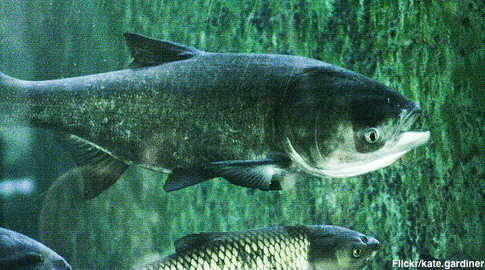
A native of China, four species of asian carp (whose weight can exceed 100 pounds) were originally imported to America by southern catfish farmers in the 1970s to eat pond algae. After floods decade ago caused some ponds in Arkansas to overflow, the fish escaped and have slowly curled their way up the Mississippi, leaping over and slipping through man-made barriers. Over time, they even made their way into the last tributaries connecting the Gulf of Mexico with Lake Michigan.
If the carp infest the lake, they will undoubtedly wreak havoc on the region’s ecosystem. By eating massive amounts of plankton and algae, the fish would essentially knock out the lowest species in the water’s food-chain, crowding out smaller fish. They also reproduce at blistering speeds; one female can produce upwards of 1 million eggs in her lifetime. “They are programmed to eat and breed,” said Jennifer Nalbone, the Navigation and Invasive Species specialist at Great Lakes United, on a conference call with reporters last week. When startled, the fish can also leap up to eight feet in the air with enough force to smash into fishing and recreational boats. While it might take years for the carp to establish a firm presence, the threats to the region’s $7 billion fishing industry, as well as the $16 billion recreational boating industry, are immense.
How close are they to Lake Michigan?
In late November, the Army Corps of Engineers validated scientific research that found the species had breached an electric barrier on the Sanitary and Ship Canal, less than 100 miles from the lake. In response, Illinois officials quickly dumped a toxic chemical into a nearly 6-mile stretch near Lockport where the fish were located, killing an estimated 100 tons of additional fish in the process. But it wasn’t enough. In late January, researchers at the University of Notre Dame identified Asian carp DNA in Lake Michigan’s Calumet Harbor near the Illinois-Indiana border. Last Tuesday, Illinois officials promised to take another shot at targeted removal. Starting this week, they will use nets and electrofishing techniques to trap the fish. While none have yet been detected in the lake itself, the urgency is clearly growing.
The dueling solutions
After convening an “Asian carp summit” with Gov. Pat Quinn and other Midwestern elected officials last week, the White House released its own $78.5 million Asian carp deterrence plan. At a crowded public hearing hosted by the U.S. Environmental Protection Agency (EPA) in Chicago on Friday, environmentalists give the administration’s proposal mixed reviews. They approved of funding for the construction of new barriers to protect against flooding, as well as expanded research into DNA monitoring and analysis. More crucially, the administration hinted for the first time it would consider periodically closing the two navigational locks along the canal several times each month — perhaps for as long as a week — which is a main priority for the green coalition. When barges pass through the lock, more poison would be thrown into the water as a partial deterrent.
Still, environmentalists expressed disappointment with the White House’s lack of a timeline or cohesive plan. “It’s like presenting a list of ingredients,” says Andy Buchsbaum of the National Wildlife Federation, “without a recipe.”
They instead stress the need to implement what the National Resource Defense Council’s Thom Cmar called, “short-term, zero tolerance policies.” More specifically, they’re arguing in favor of what’s called “ecological separation.” That means permanently separating the Great Lakes from Mississippi River Basin by shutting down the locks immediately and fully — a move six Great Lakes states and Ontario tried (and failed) to force through a court order. The Obama administration plan reserves some funding for research into the viability of such a project.
Illinois lawmakers and barge operators are already working to block the “separation” approach. At a news conference Thursday, Reps. Debbie Halvorson, Judy Biggert, and Danny Davis spoke out against any lock closures, suggesting it will hurt statewide commerce. That was also the concern of many of those who attended the public hearing Friday. Yet economic research from Wayne State University in Detroit seems to contradict their thesis. Only 7 million tons of cargo moves through the locks annually, represent less than 1 percent of all Chicago-area freight traffic. That load could be addressed by adding two trains to the fleet of over 500 that (slowly) work themselves around the city each day — a fix that would only cost $70 million per year. Cleaning out a carp-infested lake would be far more expensive.
As the debate continues over how best to prevent a possible carp invasion, here is the question at the center of it all: Will Illinois officials support the parochial interests of local businesses or make every effort to protect one of the state’s most treasured natural resources?