Devouring Time: a consuming biography of a northern Michigan legend
By Tim Mulherin
Sun contributor
“Devouring Time, blunt thou the lion’s paws” – William Shakespeare, Sonnet 19
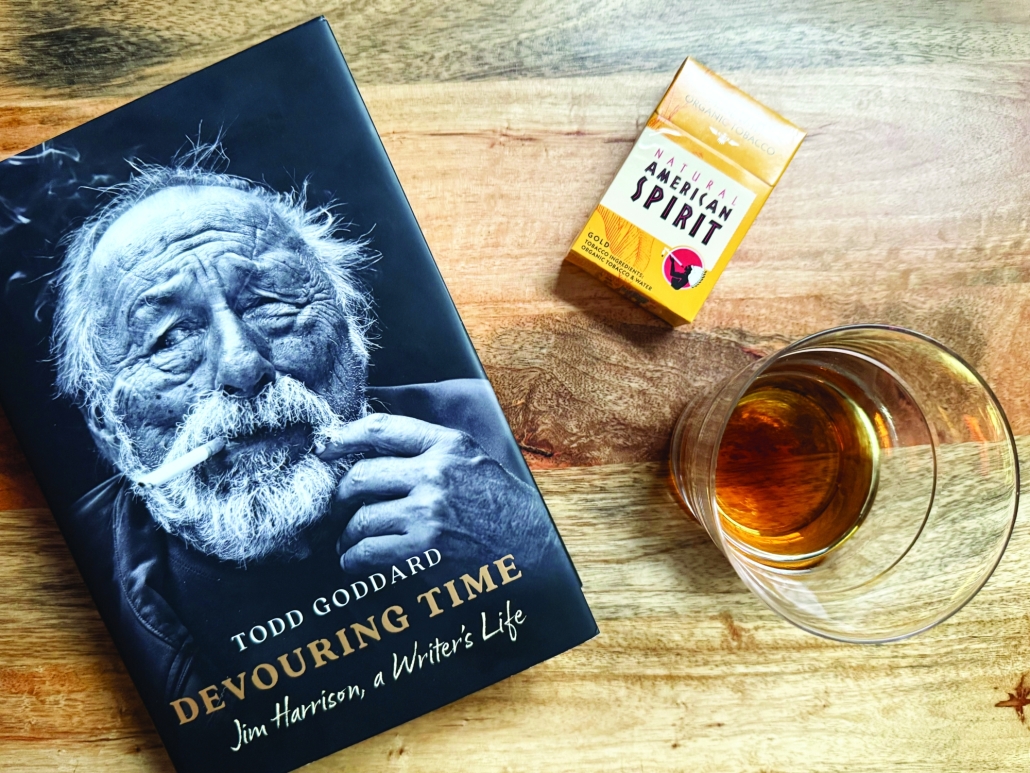
It takes nerve to write a biography about such a revered, almost mythological northern Michigan writer as Jim Harrison. Kudos to Todd Goddard for taking on such an important project for posterity with sensitivity, level appreciation, and a North Star dedication to accurately portraying this gigantic personality and prolific writer of master works of poetry and fiction.
As well, it takes some daring to share one’s impression of the Harrison biography, if I do say so myself. I’ve long been a fan of Harrison’s work. I’m in awe of his vast intellect and artistic range, his turn-of-phrase genius and ability to connect so deeply with his ardent readership.
In Devouring Time: Jim Harrison, a Writer’s Life, Harrison’s personal story parallels the chronological progression of his canon. Yet even a book as heavily researched as Devouring Time, supported by extensive primary and secondary research and its warts-and-all storytelling, cannot possibly reveal the full essence of its subject. The inner space of humanity has an unknowable dimension. Nonetheless, Goddard unpacks a plausible portrayal, which makes the book a worthy read for Harrison fans. There is not much terribly new revealed here, especially for those of us who are well acquainted with his books and articles that advanced his celebrity.
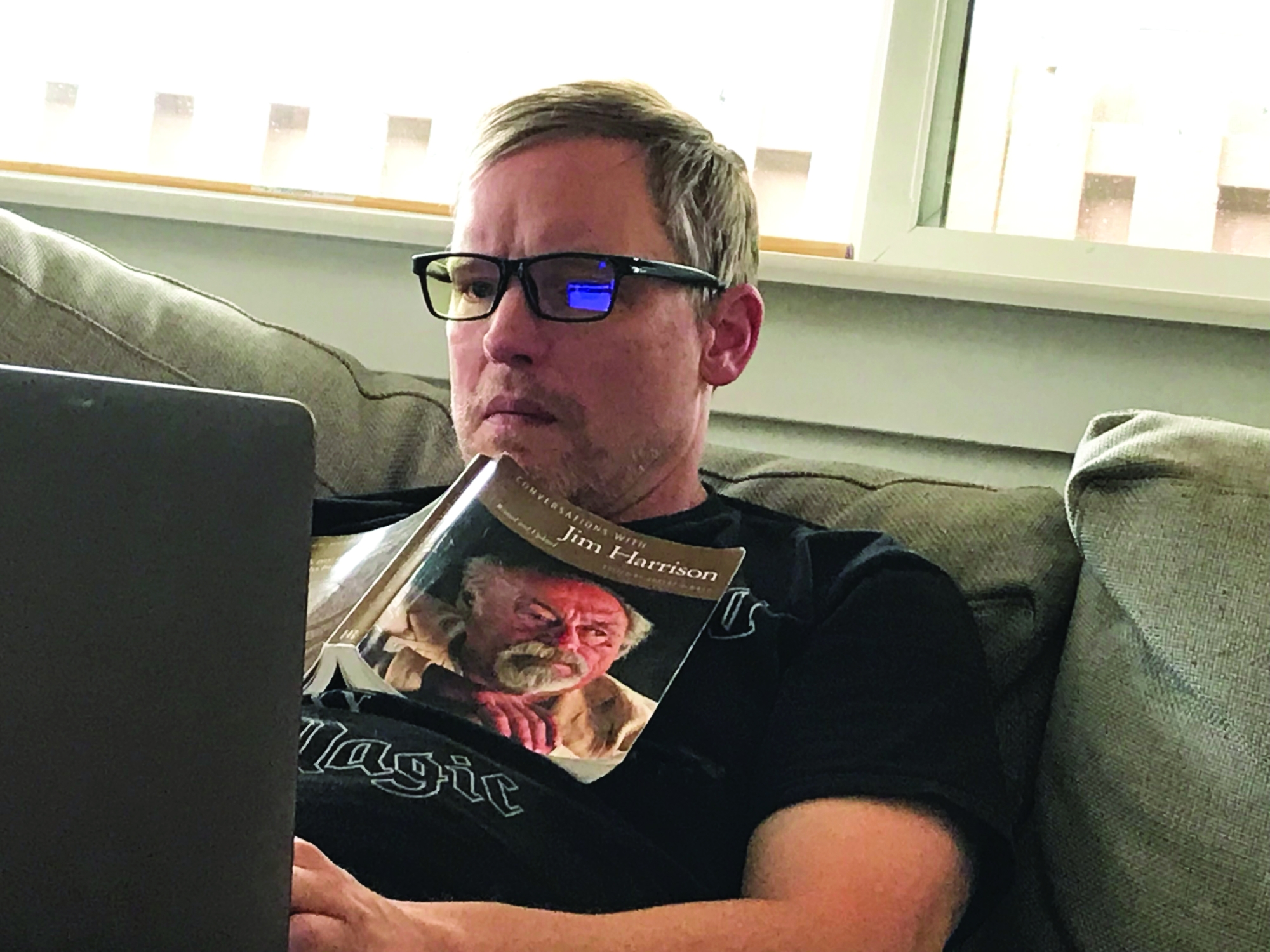
I’ve read every one of Harrison’s books, some twice; one, The English Major, three times (perhaps because I’m one). And reading is as close as I got: I never met the man in person. Which means I never had a drink with him, though I certainly would have welcomed the chance to belly up to the Bluebird bar and be regaled by the legendary northern Michigan bard. Never went trout fishing with him. That likely wouldn’t have happened anyway, as Harrison preferred the more romantic pursuit of flyfishing to that of my everyman baitcasting.
What’s more, obviously, I never had the pleasure of being in Harrison’s orbit of friends in high places, the likes of actor Jack Nicholson, novelist Tom McGuane, and chef Mario Batali. What great—and most likely sinfully excessive—adult fun that would have been. Although summary treatments are provided by Goddard, most of what happened in those merrymaking events remains known only to the participants. There is something to be said for that.
When I was bartending in the late seventies and throughout the eighties, if someone took a photo in the bar—note that dim settings require flashes—the whole barroom instantly ground to a momentary halt. The sacrilegious offender was then met with icy stares. (Today, photo documentation of nights out is practically an expectation.) Similarly, regarding the development of a biography, I contend that some things really are better left unsaid, a lesson not well understood these days.
Goddard necessarily spends considerable time highlighting Harrison’s relationship with drugs (quitting cocaine at the age of 50), alcohol (an addiction which, as documented, clearly contributed to his demise), food (Harrison’s 37-course gastronome’s dream in Burgundy, France, in 2004, covered in detail by the 2017 book A Really Big Lunch, says it all) and philandering (which had been no closely held secret, though the frequency of his while-married dalliances, as put forth in the book, came as a surprise). Yet, there is an intriguing relative silence regarding his vices from the women in his immediate circle.
His deceased wife, Linda, noted as a very private person, was quoted sparingly compared to many of the other main characters. Harrison’s assistant, Joyce Harrington Bahle, comes up in the book now and then, though not as often as expected given her central role in Harrison’s writing production and in managing his business and sometimes personal affairs. And his daughters, Jamie and Anna, are generally rather reticent about Harrison living so close to the edge with his substance abuse and gluttony.
Although I found myself clamoring for more from them all—inquiring minds want to know—upon finishing the book, I accepted what was offered without any complaint. A certain discreetness can be addition by subtraction in biographical undertakings, as Devouring Time exemplifies.
Harrison’s familial female coterie provided steady emotional support to a profoundly talented writer and just as flawed man. Without them, it seems certain that his exquisite, prolific output would never have been as considerable as it was. It also leaves me wondering, as a local bookstore owner once mentioned to me, what further genius might have been shared with the world had he not been such a heavy drinker.
On this point, I have some personal and professional insight to offer. There is something liberating about overindulgence, especially for younger writers and artists whose bodies and brains can take the punishment, that can mysteriously and positively contribute to a creative effort. However, it’s a grace that comes at a cost.
For male Harrison fans of my age—boomers, a generation that is slowly passing from this Earth—he was definitively and imperfectly a “man’s man.” For example, in promoting his first work of fiction, Wolf (1971), the publisher, Simon & Schuster “described the novel as being told from the vantage point of ‘one of the last male chauvinists of his time.’” Even back then, such openly sexist writing, though brilliantly and often humorously told, was slowly turning toward being thought of as passe by a more judgmental and enlightened society.
Although equality is a proper ambition for all of humanity to share in, I submit that the inability to laugh at ourselves and our faults—a unifying mechanism—is sadly being victimized nowadays in the process. Harrison understood the risk in being so plainspoken and bawdy. I love him for it yet today.
Two of his most frequently appearing protagonists in his novellas, Brown Dog, the generous-to-a-fault, alcohol-loving outdoorsman, a half Finn/half Michigan Chippewa Indian, and Detective Sunderson, a retired Michigan State Police gumshoe from the Upper Peninsula, were easily and unrepentantly enchanted by women. I can’t help but laugh out loud when reading their unlikely encounters of the amorous kind. Harrison deeply understood the landscape of the male mind, including its most primitive side, its drive and appetites.
Yet writing the novel Dalva (1988) and its follow-up, the sweeping The Road Home (1998), in the remarkably convincing voice of his lead female character, fooled all his critics who accused him of sexism in his writing, of which Harrison was firmly unapologetic. He had a story to tell and knew how to get there.
The poet/novelist/novella virtuoso/essayist spoke to me in all these varied genres that framed his creative thinking. He movingly conveyed his abiding affection for the outdoors. Fascination with songbirds. Desire for solitude. Reverence for trout streams and their creatures. Fondness for upland game hunting with a loyal bird dog and a good friend. Mixed yet entirely compatible sense of Buddhist/Christian/Animist spirituality. Appreciation of cocktail-inspired conversation. Gut-busting sense of humor. Intolerance for fools. And an awe of the universe and how he miraculously happened to show up in it.
You can’t get that unique package just anywhere. It has to be Harrison.
Pondering the Harrison biography calls to mind a personal anecdote. My Great Uncle George’s man cave in Paterson, New Jersey, had an irresistible aura about it, especially for a 10-year-old boy. (Aside from William Carlos Williams’ epic poem of the same name, perhaps Paterson is most famous for the Passaic Falls murder scene in The Sopranos.) It was there, on steamy summer afternoons in the mid-sixties, where I would settle in front of the industrial-sized window fan and eagerly peek at my uncle’s stack of men’s adventure magazines like Argosy and the more titillating True Men with its curvaceous, Nazi-enslaved or under-wild-animal-attack innocent women on the cover, desperate for rescue. I didn’t yet understand male adult yearnings then, but they were certainly beginning to stir.
On the wall facing my chair was a large chromolithographic print of “Custer’s Last Fight,” painted in 1884 by Cassilly Adams. For years, Anheuser-Busch distributed the Battle of the Little Bighorn print to bars across the country, up until the early seventies. Lt. Col. George Armstrong Custer is heroically depicted as the last white man standing in his glorious going out while the dead and the mortally wounded are being summarily scalped. As 19th century western America historians have noted, Adams took some painterly liberties in depicting that historically fraught moment. Yet it fired my young imagination.
I’m certain that the enigmatic Jim Harrison, who viscerally and artfully understood what made men tick, would get a kick out of that painting and my uncle’s men-only (and men-in-the-making-only) sanctum. In writing about such a setting, he would have had a field day with it.
Goddard’s discerning, probing-as-needed biography of arguably Michigan’s foremost man of letters—certainly Leelanau County’s—a literary contribution that Harrison’s readers will want on their bookshelf, may well spark similar uniquely personal associations. Such was the power of Harrison’s pen.
Whether relating his insatiable hunger for earthly delights through his male characters or surprising us with his Dalva-esque understanding of the female perspective, this much is certain: Damn, Jim Harrison could write.
Tim Mulherin’s latest book is This Magnetic North: Candid Conversations on a Changing Northern Michigan. He is currently writing a book on Michigan and Indiana wildlife.