Collecting Rocks in Leelanau

By Sandra Serra Bradshaw
Sun contributor
Who among us in Leelanau has not walked our lovely beaches and often pick up an interesting rock or two? We may have sometimes wondered just what the seemingly endless array of rocks strewn on the beaches exactly are. What are they made up of, how did they get here, and where did they come from? Most importantly, what stories might they tell us?
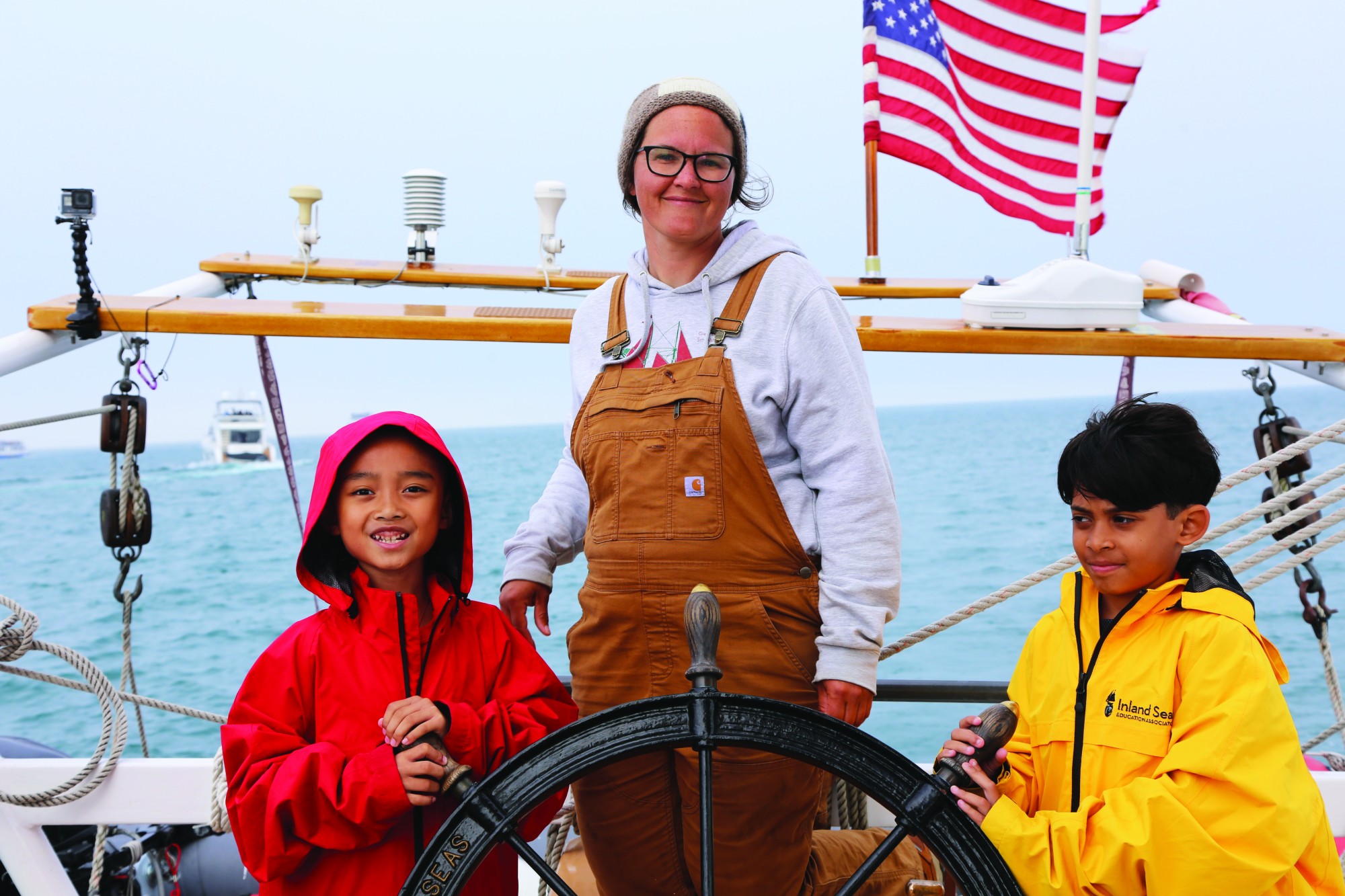
The Inland Seas Education Association (ISEA) held a seminar/cafe on this very topic earlier this year. It was entitled, The Great Lakes Origin—A Story of Fire and Ice. “ISEA Cafes are a way for us to connect in the non-sailing season,” and continue our mission of ongoing learning about the Great Lakes,” said ISEA Executive Director, Fred Sitkins. “At the café you will learn about the rocks you find along the beach and how they tell the story of this area from time immemorial.”
Geologists who study rocks often liken them to pages in a book, written in a language they study and learn to read. Close examination of rocks will divulge their secrets and yield fascinating truths about our Earth and show their age and their transition through time. This investigation reveals processes that were – and more importantly still are at work for billions of years in the making. Even a simple, mundane rock has a story to share. Their story—a true one—all began with fire and ice.
Northern Michigan is a fantastic area for rock collecting, and with all the many to find, rockhounding is a popular past time, and in fact there are millions and more of them growing in the Unites States doing just that each year. It’s a hobby with endless variety, and rockhounds may even love their sport so much that they become collectors. Their main interest is in collecting specimens, culminating in the satisfaction they get from the beauty of color and form found in nature.
“It is a favorite hobby of mine,” said John McKinney, retired MSU Sea Grant Agent. “Rock formations and loose rocks have fascinated me my entire long life. Quartz crystals from cliffs and beaches in Ireland (Kerry diamonds), fossils from beaches and cliffs in the Shiant islands of the Outer Hebrides of Scotland and even rocks found in Ohio where I grew up provide education and intrigue,” he related. McKinny and I share fond memories of when we collected stones together with our families and friends out on South Fox Island in past years.
“The amazing variety of shoreline rocks here in northwest Michigan have given me endless hours of fun trying to identify their types and speculate on their origins,” McKinney said. “Beach rocks are a mix of glacial debris carried down by glaciers and remains left in sediments deposited by ancient warm water seas.”
When you, as a rockhound, learn to interpret the stories told in the languages of geology, the hobby and the science will take on new depth and meaning, making their pages an enjoyable and revealing read. As amateur collectors, many make substantial contributions to paleontology (fossils), mineralogy (minerals) and archaeology (ancient man).
Trisha Smrecak, PH.D, former Education Coordinator at ISEA, was the presenter at the Fire and Ice Café. She spoke to a packed room, where all of us were held in fascination as she traced earth’s heritage through millions of years in time. Smrecak’s expertise comes from her deep time perspective. As a paleontologist, she connects ancient organisms to the habitats in which they lived—primarily oceans—and how changes in those habitats impact the creatures who live there.
The Great Lakes are just one of the many invaluable systems being altered by climate change, and she looks forward to helping others make connections between the water in their backyard and global climate changes. When she’s not out on the bay teaching folks about the Great Lakes, Trisha is hiking through the woods with her husband, two children, and their dog.
“I grew up on the east side of the state,” she explained. “A first-generation college student who really like rocks and fossils and the story they tell.” Smrecak found her fit by combining her love of science, becoming a paleontologist, and now be able to blend her knowledge teaching others about science. “Teaching young students is a springboard,” Smrecak explained. “Science is based on moving forward. Just because I have knowledge I might be surprised.” What she does in her students is to instill curiosity, “less about knowledge and more about the process,” she added. “Actual science- the process of asking questions. Questions in creative ways. And the more you know, the more questions you ask!”
Michigan’s official state stone, the Petoskey stone and its lesser-known cousin, the Charlevoix stone, are favored treasures for rock hunters to find. Though elusive and sometimes tricky to locate, they are a beloved symbol of our Great Lakes and the magnificent shores they are found upon. The Petoskey stone, Michigan’s state stone, is the most popular and well-known rock that many hope to find. Then there is the Charlevoix stone; many coin it the Petoskey stone’s “cousin.” The Petoskey and Charlevoix stones are fossilized pre-historic coral that is roughly 350 million years during the Devonian Age. These stones are distinguishable based on their unique exoskeleton structures. Did you know that these fossils are older than dinosaurs? That’s old!
“The Petosky and Charlevoix stones found on our beaches are well known as petrified sea life of several hundred million years ago,” McKinney explained. “Also interesting are what can be found in Michigan limestone quarry debris. The quarrying operations leave piles of ‘waste’ and if you can get to them, you will often find whole petrified corals and many other petrified ancient life forms frozen in time, uneroded and identifiable.”
So, where here in Leelanau County might you find the Petoskey or Charlevoix stones? Of course, the first place for many to think of for rock hunting is along the Sleeping Bear Dunes National Lakeshore. But please take heed: it is illegal to collect any rocks from within the boundaries of any national park or national lakeshore.
“The Lakeshore as a National Park is highly significant to the American people. It has a heightened level of protection. Because the park is a National Resource, things that are not renewable need to be left where they are. That allows the next visitor to enjoy them too. You may pick them up, but please leave them where you found them,” said Merrith Baughman, chief of interpretation and visitor services at the Sleeping Bear Dunes National Lakeshore.
“I have seen visitors take full buckets of the stones home. We have 1.7 million visitors a year visit our park,” Baughman related. “How long would it be for the things that make the park so special—including the Petoskey stones—just disappear if they were allowed to be taken?” she asked. “Because the park is a national resource, we follow the rule: “Leave things as they are; Leave no trace.”
“On the other hand, berries, apples, mushrooms, those things have roots and will give more fruit are fine to be picked in limited quantities for personal use. They are renewable resources,” Baughman said. “But, on the other hand, along with the stones, taking ramps and any historic objects are prohibited. They are not allowed to be taken off parkland.”
Know the law; state laws say you cannot collect more than 25 pounds of stones, minerals, or fossils per year from Michigan beaches, but each beach or state park may have its own policies. If you happen to want to take a 25-pound rock home from allowable land, that one rock is your limit for the year. Remember, in National Parks you cannot collect or remove rocks.
You also have the option to collect stones on private property, provided you have the permission of the landowner and then there are no limits. Other possibilities may include municipal parks and beaches, unless otherwise stipulated as prohibited.
As with any hobby, educating oneself along the way is always most helpful. Beachcombers and collectors of geologic treasures of Leelanau and other Great Lakes areas will find the Enerdyne in Suttons Bay a treasure trove in of itself for their rock hounding supplies, equipment, maps, and books. Stop by there with your questions, there is always someone there to help.
As a final note, it may be a nice idea when you are out on your rock hunting excursions to take along a garbage bag. Collecting cans, glass, paper and so many other left-behind human trappings we are all allowed to freely remove!