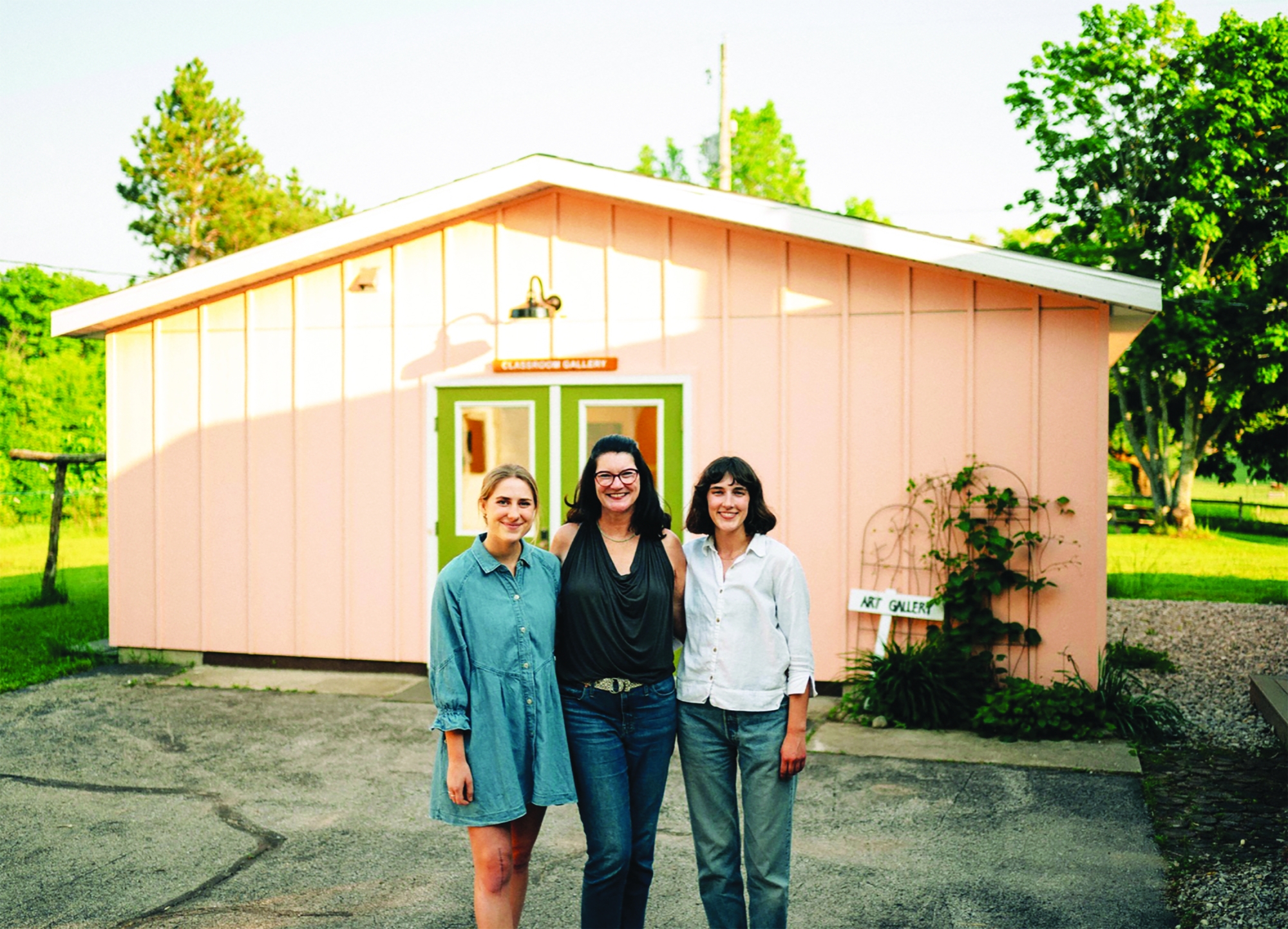
Imagine putting in the interminable work required to face down alcoholism and maintain your sobriety for 30 years. Through that journey, you mentor dozens of other women in the throes of their own addiction recovery. Now imagine your world is rocked by a rare neurodegenerative disease called Primary Lateral Sclerosis (PLS) that, among other cruel symptoms, causes your speech to slur. Most people would feel justified in reacting with anger or indignation but not Tricia Denton of Maple City. “I just found it humorous. We always have the opportunity to turn those situations into teaching and awareness opportunities,” she says with remarkable grace. Click here to read more, and find a link to support Denton’s GoFundMe campaign.

Leelanau County resident Michael Klachefsy, who was born in Germany in 1947, has shared his parents’ Holocaust survival story with local school classes, including at Glen Lake and Leelanau School. On the 80th anniversary of VE Day—the end of the Second World War in Europe, the Sun is sharing his family’s story.

Our story series celebrating songs inspired by Leelanau County and the Sleeping Bear Dunes continues with Seth Bernard’s “Manitou,” an instrumental that he wrote in June 2019 during a residency sponsored by the Old Art Building in Leland. “I wrote this simple piece on acoustic guitar looking out over the islands near Van’s Beach around sundown,” said Bernard. “It’s a little magic carpet ride to that peaceful, serene, early summer Leelanau sunset vibe. Bernard returns to the Old Art Building on April 24 at 7 pm for an Earth Week-themed concert.

What would you call a cozy retail shop that sells books, plants and art? Oh, it also hosts music and some craft workshops. Don’t forget the occasional food truck, and whatever else Rachel Zemanek dreams up. Unsure what to call it? Zemanek calls it a snuggery. The dictionary definition is “a cozy or comfortable place,” which is just what she intends it to be. “It combines my love of nature and books,” Zemanek says. You can also call it The Folded Leaf, because that’s what she’s calling it. She named it for the way some people mark their place in a book. The fact that those are also the organs of a plant that provide sustenance is a happy coincidence. The Folded Leaf is located at 9044 S Kasson Street, across from the Cedar Tavern. Cedar’s newest retail entry is scheduled to open April 26.

Holly T. Bird, a local attorney, indigenous activist, and member of the Traverse City Area Public Schools Board of Education—and whose family had roots on Little Glen Lake—joined the ancestors on April 3. Bird was co-executive director of TitleTrack and advocated for everything from indigenous visibility and racial justice, to clean water and energy, to LGTBQ+ rights. A proud member of the Thunder Clan, she traced her heritage from Apache, Yaqui, and Perépucha Tribes and joined the Standing Rock protests against the Dakota Access Pipe Line in North Dakota in 2016. Click here to read the poignant note Bird wrote to her friend, now State Rep. Betsy Coffia, in September 2018.

Longtime Glen Arbor custodian Leonard Ole Thoreson, passed away on March 15 at age 98. Thoreson was born on November 28, 1926, in Port Oneida (on the Thoreson Farm). As a young boy his father worked the fields with horses until he purchased the Ford Tractor that is on the farm today. A lifelong resident of Leelanau County, Thoreson served in the U.S. Army during World War II and was a dedicated member of St. Philip Neri Catholic Church.

Our story series celebrating songs inspired by Leelanau County and the Sleeping Bear Dunes continues with Blake Elliott’s “Small Town,” which the singer-songwriter released in 2012 “after a really hard winter.” The song offers an homage to “how our little communities in Leelanau County show up and helped us through.” State Rep. Betsy Coffia used “Small Town” for her first official political campaign song when she ran for Grand Traverse County Commission. The Accidentals took part in the recording for the music video of “Small Town,” which was filmed and recorded at Halohorn studios in Leelanau County with Andy Van Guilder.

Ready or not, here they come. The endangered, migratory Piping Plover birds will return to Sleeping Bear Dunes National Lakeshore in April and set up their stony nests—regardless of National Park staff cuts and federal politics. Sleeping Bear staff might not be able to hire all the seasonal employees it needs to work with the shorebirds—or those workers might not arrive on time—since the federal hiring process resumed late in the winter. In their potential absence, volunteers are stepping forward. Grawn resident Maryellen Newport is recruiting local volunteers to monitor and protect the Piping Plover from predators. Read the story for a link to sign up.

For Jim and Jan Brown, ’tis the season. No, not that one, and really not even really a holiday at all. But there is a season for making maple syrup. If there was a holiday attached to it, it’s a safe bet the Northport couple would be nearly as well-known as Santa and Rudolph. Each year around this time, they take to the woods, tapping the maple trees on a portion of their 42 acres south of Northport. They drill the spials into the trees, put out the buckets and gather the sap, then turn it into the liquid gold beloved by so many. “I’ve been doing it since 2009,” says Jim, a.k.a. Pa Brown. That’s what his grandson Rance called him. After Rance passed away from brain cancer in 2010, Jim and Jan decided to sell their syrup under the brand name Pa Brown’s Maple Syrup, and send the proceeds from sales to St. Jude’s Children’s Hospital. Though Rance lost his battle with brain cancer, Jim and Jan were touched by the care and thoughtfulness of the staff at St. Jude’s. “So, I chose to give all the proceeds (there).”

UPDATE (March 12): The National Park Service once again has the green light to hire seasonal workers, but the late start has hampered the ability of Sleeping Bear Dunes to populate its seasonal roster. As of Glen Arbor Sun press time, approximately 80 percent of the National Lakeshore’s more than 100 seasonal positions remained vacant. The federal government chaos and the inability of seasonals from outside the area to find housing has prompted a slew of declines from candidates who were suddenly called and offered seasonal positions in March. Sleeping Bear Dunes staff have been paralyzed in other ways, too. Government-issued credit cards used by Park staff are frozen. They can’t buy ammunition or ranger supplies; they can’t even buy toilet paper for outhouses at hiking trails.