Emily Modrall drew an audience of 150 to Suttons Bay High School on Nov. 29 where she summarized the Kchi Wiikwedong Anishinaabe History Project and its work to give more space and visibility to the Anishinaabe past and present through signage and art on public land. A fascination with history led Modrall, who grew up in Suttons Bay, to a Ph.D. in Art & Archeology from the University of Pennsylvania and 15 years of field work in Italy. But upon returning home, this region’s own history seemed far away. Two years ago, Modrall ran across a marker at West End Beach etched “OLD INDIAN TRAIL” which she learned led south to Cadillac and was used by the Anishinaabek more than a century ago. Most of these trails are now lost to history—or paved over. Modrall describes herself in that moment unmoored, as she felt the history of her home and birthplace shifting beneath her feet. “What was this old trail?” She remembers wondering, “Who put up this marker? And what more can we do to preserve the past?”
During 2023, Suttons Bay resident Rebecca Gearing Carlson has researched and written a series of narrative historical pieces about Leelanau County farming families, which we have published in the Glen Arbor Sun. Read those stories here.
Share this:
- Share on Facebook (Opens in new window) Facebook
- Share on X (Opens in new window) X
- Email a link to a friend (Opens in new window) Email
- Share on Reddit (Opens in new window) Reddit
- Share on Pinterest (Opens in new window) Pinterest
- Share on LinkedIn (Opens in new window) LinkedIn
- Print (Opens in new window) Print
- Share on Tumblr (Opens in new window) Tumblr
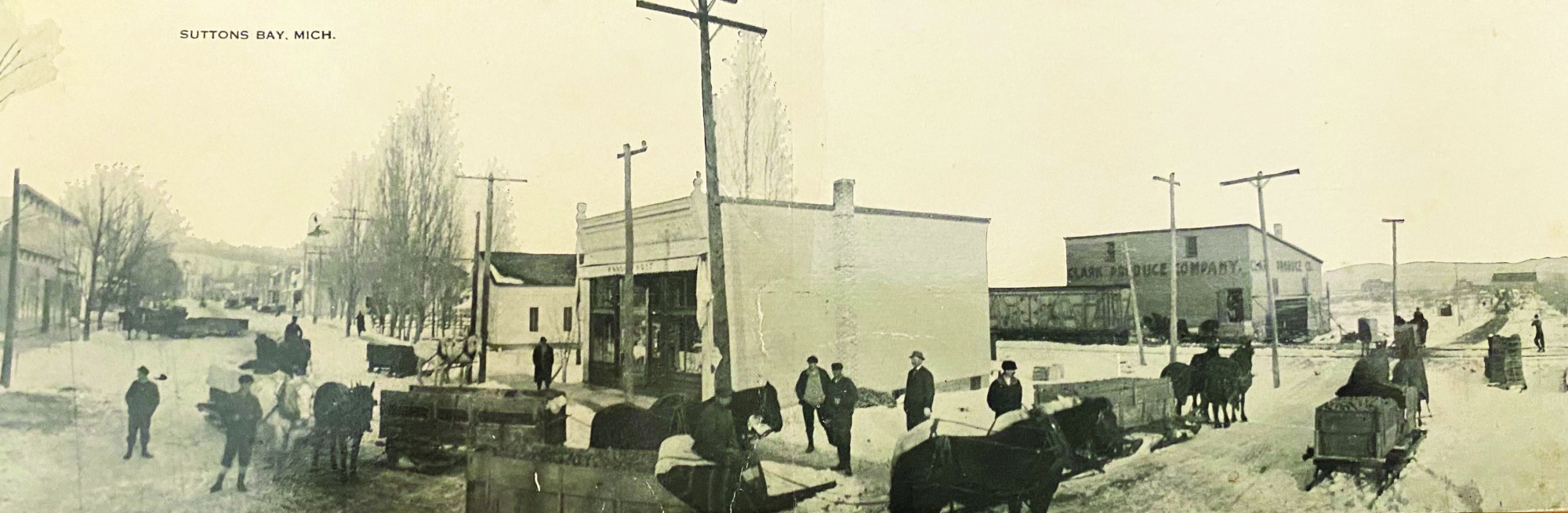
“Every time I walked into Eddie’s Village Inn restaurant in Suttons Bay (currently the V.I. Grill), the black and white vintage photos on the walls created a time capsule effect,” writes Rebecca Carlson in part 11 of our Leelanau farming families series. “Eddie and Mary Lou (Walter) Rothgarber carefully curated this amazing collection that they shared with every guest who walked into their restaurant. As the tapestry of pictures narrated the story of Suttons Bay and the surrounding area, the restaurant served as a semi-historical museum.”
Share this:
- Share on Facebook (Opens in new window) Facebook
- Share on X (Opens in new window) X
- Email a link to a friend (Opens in new window) Email
- Share on Reddit (Opens in new window) Reddit
- Share on Pinterest (Opens in new window) Pinterest
- Share on LinkedIn (Opens in new window) LinkedIn
- Print (Opens in new window) Print
- Share on Tumblr (Opens in new window) Tumblr
Join the Leelanau Historical Society and the Omena Historical Society on Wednesday, Nov. 29, at the Suttons Bay High School Auditorium for “A Kchi Wiikwedong Anishinaabe History Project Summary: talking about the past for the present (and the future).” This free event is open to the public. The Kchi Wiikwedong Anishinaabe History Project was started in 2021 by Emily Modrall in an effort to bring greater visibility and awareness to the very long history of this region as an Anishinaabe homeland. Her presentation this evening summarizes this project and its outcomes as the project enters its final months.
Share this:
- Share on Facebook (Opens in new window) Facebook
- Share on X (Opens in new window) X
- Email a link to a friend (Opens in new window) Email
- Share on Reddit (Opens in new window) Reddit
- Share on Pinterest (Opens in new window) Pinterest
- Share on LinkedIn (Opens in new window) LinkedIn
- Print (Opens in new window) Print
- Share on Tumblr (Opens in new window) Tumblr
A gathering of more than 130 returned to Camp Kohahna at Pyramid Point on Labor Day weekend to pay tribute to 100 extraordinary years of camping. Women came from across the country, and as far away as London to join this weeklong Centennial Celebration, Aug 29-Sept 4. It was an opportunity to be together with old friends, reminisce and experience the freedom of being kids again at Camp Kohahna.
Share this:
- Share on Facebook (Opens in new window) Facebook
- Share on X (Opens in new window) X
- Email a link to a friend (Opens in new window) Email
- Share on Reddit (Opens in new window) Reddit
- Share on Pinterest (Opens in new window) Pinterest
- Share on LinkedIn (Opens in new window) LinkedIn
- Print (Opens in new window) Print
- Share on Tumblr (Opens in new window) Tumblr
With all the prodigious natural benefits the honey bee affords the world at large, it is not surprising that honey bees play such an integral role in the world of farming for Julius Kolarik. Click here to read Part 10 of Rebecca Carlson’s Leelanau Farming Family series.
Share this:
- Share on Facebook (Opens in new window) Facebook
- Share on X (Opens in new window) X
- Email a link to a friend (Opens in new window) Email
- Share on Reddit (Opens in new window) Reddit
- Share on Pinterest (Opens in new window) Pinterest
- Share on LinkedIn (Opens in new window) LinkedIn
- Print (Opens in new window) Print
- Share on Tumblr (Opens in new window) Tumblr
October 9 is Indigenous Peoples’ Day—previously observed as Columbus Day—and we pondered which Native American books are authentic, and which ones should we read and teach our children to understand the history and current impact of First Nations peoples in northern Michigan and throughout North America. “I encourage people to ask themselves a few pointed and potentially uncomfortable questions when selecting books,” said Tricia Denton. “Who does the writing, publishing and sale of the book benefit? What perspectives does it portray?” This story also offers a list of Native American- themed books available at Bay Books in Suttons Bay (and other Leelanau County bookstores).
Share this:
- Share on Facebook (Opens in new window) Facebook
- Share on X (Opens in new window) X
- Email a link to a friend (Opens in new window) Email
- Share on Reddit (Opens in new window) Reddit
- Share on Pinterest (Opens in new window) Pinterest
- Share on LinkedIn (Opens in new window) LinkedIn
- Print (Opens in new window) Print
- Share on Tumblr (Opens in new window) Tumblr
John Houdek arrived in the Leelanau area in the 1860s with wife Barbara and brother Wenzel, all from Bohemia, writes Rebecca Carlson in the latest installment in her series about the legacy of Leelanau farming families. The brothers settled and homesteaded in the area north of Leland and south of the Gills Pier Saw Mill, owning around 400 acres of land, according to the 1880 plat map. The farms and acreage of these two brothers got passed down through the next three generations. John and his wife Barbara were parents to nine children who became integral parts to the family farm and Gills Pier community.
Share this:
- Share on Facebook (Opens in new window) Facebook
- Share on X (Opens in new window) X
- Email a link to a friend (Opens in new window) Email
- Share on Reddit (Opens in new window) Reddit
- Share on Pinterest (Opens in new window) Pinterest
- Share on LinkedIn (Opens in new window) LinkedIn
- Print (Opens in new window) Print
- Share on Tumblr (Opens in new window) Tumblr
Sleeping Bear Dunes National Lakeshore deputy superintendent Tom Ulrich, who will retire from the Park later this month, once heard a poignant analogy at a leadership conference that compared the old style of managing a National Park to the Star Wars jedi master Obi-Wan Kenobi, who deftly and constantly fends off outside threats with his light saber. By contrast, the new style of Park management is not to deflect or fight off criticism from the public, but to engage, listen and teach as Yoda does. Ulrich arrived at Sleeping Bear Dunes in late 2002 at a time when Lakeshore staff was reeling from widespread criticism after it promoted an unpopular new General Management Plan that would expand portions of the Park classified as “wilderness.” His tenure at Sleeping Bear Dunes dawned a collaborative relationship between the Park and local citizens.
Share this:
- Share on Facebook (Opens in new window) Facebook
- Share on X (Opens in new window) X
- Email a link to a friend (Opens in new window) Email
- Share on Reddit (Opens in new window) Reddit
- Share on Pinterest (Opens in new window) Pinterest
- Share on LinkedIn (Opens in new window) LinkedIn
- Print (Opens in new window) Print
- Share on Tumblr (Opens in new window) Tumblr
Two Weeks in a Hammock is an education and outreach initiative by Cedar residents Vince and Stacie Longwell Sadowski to inspire regular folks to get out into nature. “As two middle-aged people with average fitness levels and more time than money,” they write on their blog, “we model an active lifestyle of adventure. The Sun recently interviewed them about their “Voices of North Manitou Island” project, a series of videos launched this year that explore the history of the North Manitou Island in the Sleeping Bear Dunes National Lakeshore through the people who have lived, worked, played, and been a part of island life over the years.
Share this:
- Share on Facebook (Opens in new window) Facebook
- Share on X (Opens in new window) X
- Email a link to a friend (Opens in new window) Email
- Share on Reddit (Opens in new window) Reddit
- Share on Pinterest (Opens in new window) Pinterest
- Share on LinkedIn (Opens in new window) LinkedIn
- Print (Opens in new window) Print
- Share on Tumblr (Opens in new window) Tumblr