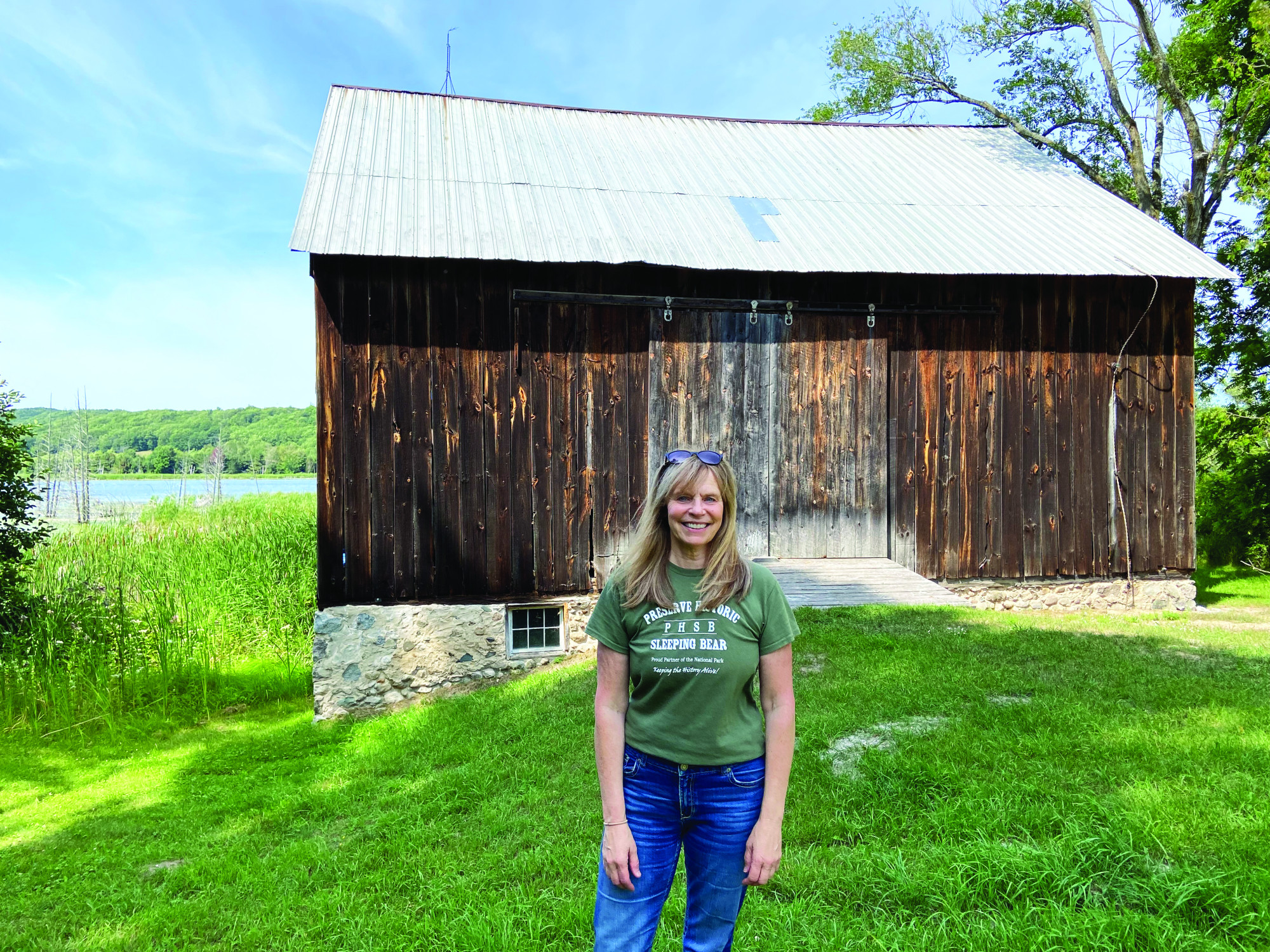
Preserve Historic Sleeping Bear seeks to raise $50,000 to move the Goffar Barn in the National Lakeshore out of Narada Lake. The lake, east of the Port Oneida Rural Historic District, is a quiet spot to view wildlife from the Sleeping Bear Heritage Trail boardwalk. But the 150-year-old barn is in danger of being lost, as its timber posts sit precariously in water and mud from encroaching water levels due primarily to beaver activity. The preservation project for the 25-year-old nonprofit is to move the barn away from the lake about 80 feet toward the Goffar farmhouse, which was recently restored by the National Park.

Novelist Sarah Shoemaker of Northport has been an educator, university research librarian, world traveler, wife, mother, and grandmother. She recently spoke with the Sun about her most recent books, Children of the Catastrophe (2022) and Mr. Rochester (2017). Shoemaker will appear at the Glen Arbor Arts Center on Saturday, Aug. 26, at 11 a.m. for “Coffee With the Authors.” Other events this fall can be found on her website, SarahShoemaker.net.

Ghost towns—sometimes called “boomtowns”—were formerly bustling communities where a natural resource, such as gold, was exploited and subsequently depleted, then the town was quickly abandoned. Most people are aware of Wild West ghost towns, such as California’s famous Tombstone or Bodie, but they are generally unaware of northern Michigan’s host of ghost towns, built not upon gold but timber.  Aral is one such Michigan ghost town. If you ever put on your bathing suit to swim at Otter Creek/the dead end of Esch Road, just off M-22 in the Sleeping Bear Dunes National Lakeshore, you have driven past the old schoolhouse and continued down the main street of that ghost town to the beach, and you just did not know it. 

Martin Korson’s great-grandfather, Martin, was one of the Bohemian families who settled the Gill’s Pier area, writes Rebecca Gearing Carlson in installment seven of our Leelanau Farming Family Series. Korson, pronounced Keer-shan, first settled and worked in Leland at the charcoal foundry that fueled the steam ships running Lake Michigan. Then the work became about clearing the land for homes and farms. Thus, timbering and the saw mill at Gill’s Pier gained importance as the community grew.

Bohemian Valley, Bohemian Beach, Bohemian Road, the Bohemian Settlement, and the Bohemian Cemetery. From where does the name Bohemian originate and why do we find it in Leelanau County? Rebecca Gearing Carlson asks this question in part six of our Leelanau Farming Family Series. “When I think of the word Bohemian, the social and cultural movement of the 19th century comes to mind: writers, journalists, painters, actors, and other creative people living outside the norms of society. Thackeray’s Vanity Fair, Puccini’s La Boheme, and Bizet’s Carmen are beautifully written stories about the Bohemians who purposely pushed the accepted limits of societal practices and despised conventionality. The only similarities, however, between Bohemianism and the central European Bohemians are the names.”

The Glen Arbor Arts Center (previously called the Glen Arbor Art Association) celebrates 40 years in 2023. We republished this excerpt from the Arts Center’s website that recounts the organization’s history, beginning with its founders, Becky Thatcher, Ananda and Ben Bricker, Midge Obata, Suzanne Wilson, Richard and Barbara Sander, and Barbara Siepker.

“In wine, there is truth.” Overquoted? Maybe. But in the case of the early winery owners and their family members of the Leelanau Peninsula, the expression holds true. Writing for the Glen Arbor Sun, Rebecca Carlson set out to understand the origins of the current successful wine industry in Leelanau. Through years of experimenting, working and taming the soil and vines, “In Vino Veritas” is in the lifeblood of these early Leelanau Peninsula vintners.

Many years ago, on a freezing February night, I walked outside my childhood home on Indian Hill Road—nestled in the middle of nowhere, between Empire and Honor—and was taken aback by the sight of a deep, dark red moon, writes Christina Steele. Confused by the color, I tipped my head up to gaze at what I anticipated would be a starlit sky. Expecting to see Orion and Polaris, I instead let out a gasp as I saw ribbons of red light moving above me. The ribbons, curtains, and strobes of red light danced in the sky and across the moon and came to a single point directly above me. I ran back inside, hollered for my mother and my three little sisters, and grabbed as many blankets as I could hold. My family and I sat bundled together in the cold, gazing at our first Northern Lights (aurora borealis) display.

In the summer of 1994, I met a northern Michigan writer—though not in person—who made a lasting impression on me: Leelanau County’s own, essayist Kathleen Stocking. I soon came across Stocking’s first book: Letters from the Leelanau: Essays of People and Place. After examining the front and back covers and conducting my open-any-page-and-decide test, I had to have it. Here was a writer who grew up in Leelanau County, whose family had a remarkable history in the area (notably, the Pierce Stocking Scenic Drive in Sleeping Bear Dunes National Lakeshore is named after her father), and who, as I would read, captured the essence of this special place. Little did I know that this would lead to an improbable encounter nearly three decades later.

Part five of Rebecca Carlson’s Leelanau Farming Family Series features the Steimel family, which arrived in the area in the 1860s from Germany, homesteading shortly after arriving. By the 1881 Leelanau County plat maps, the Steimels held several different properties in and around Suttons Bay.