
Area jerky artisans preserve traditions
 Pat Stinson
Sun contributor
Just as area bread bakers, brewers, chocolatiers, and wine and ice cream makers have artfully expanded on a basic recipe of essential ingredients, so too have five jerky outlets located within the Glen Arbor Sun’s readership radius: Bunting’s Cedar Market and Pleva’s Meats in Cedar, Gabe’s Country Market in Maple City, Anderson’s IGA in Glen Arbor, Michigan and Deering’s Food Market in Empire.
“Most small-town places make it,” said owner Phil Deering about the popular snack food that his store has provided since the 1950s. “We have our own different formulas.”
As Deering explained, the final product is a reflection of the meats, seasonings and processes used. The latter might include brining or marinating, rubbing, pressing, grinding and drying, as well as smoking the meat to impart a distinct flavor.
Each of the five area markets uses the imagination and skill of those behind the counter to make what can only be described as artisanal jerky. Their equipment and facilities are modern, but their methods sometimes aren’t much different than those practiced by the ancient Egyptians, South American Incas and North American Indians.
Strong sales inspire innovation
 Five hundred years after the Incan (Quechua) word for dried meat, ch’arki, found its way into the vocabulary of the New World (whose inhabitants pronounced it “jerky”), the art and craft of curing, drying and smoking meat is still practiced on the continent, thanks to the demand for quick snack food. In 2004, Jim Beam Kentucky Bourbon-soaked beef jerky hit the market, and in 2006, Harley-Davidson added its name to beef jerky manufactured by ConAgra. One name-brand maker of jerky is selling in such volume, it now imports beef from South America. A regional online seller maintains an e-list of 5,000 customers and saw its revenue increase by $200,000 last year. As a result of a 2008 feasibility study, a $110 million beef jerky and pork rind processing plant employing 750 people will be located in south-central Kentucky.
The growing market for jerky has motivated some manufacturers to create special logos and packaging to better “brand” jerky products, one going so far as to trademark a clear polypropylene canister with a snap-on lid. Small, specialty makers are cropping up everywhere. Some infuse their jerky with fruit compote. Others make organic jerky. One even offers meat-free versions made from soy, seitan (wheat gluten) or mushrooms.
Back in the Leelanau villages, the market is reportedly strong without gimmicks or trends. “Locals” might buy jerky year-‘round, but tourists and second homeowners seeking quick snack food and local meat products contribute to a spike in summer jerky sales, according to the five markets. All agreed that their strongest seller, by far, is their “original,” “regular” or “plain” beef jerky flavor, which might vary widely by recipe (but usually includes some degree of peppering). If the traditional beef flavor is their best seller, why make anything else?
“We’ve expanded into other varieties,” Deering said. “It’s the evolution of the business as (jerky is) becoming more popular. Look how many different kinds of potato chips there are, jalapeño and the rest. We’re just trying to hit another market,” he explained, adding that someone who doesn’t appreciate traditional beef jerky might enjoy a newer flavor.
West side homemade jerky
Deering said his meat department employees, (four in the summer, two in winter), use all of the processes he described earlier to make the store’s jerky. Several days are needed to strip the meat, brine or rub it, let it set, then lay it out in the smoker. Beef, chicken, turkey and buffalo (from Oleson’s) is soaked in brine or rubbed with seasonings before being placed over hickory chips (and sometimes cherry wood) in the smokehouse. Honey is used for honey-sweet flavors of Chicken, BBQ Beef or Turkey. Local maple syrup finds its way into other recipes. Besides “regular,” there’s Teriyaki, Hot and Mesquite Cherry flavors. Wyatt Deering, who has made jerky for the last five years, said that some of the jerky recipes originated from special orders.
By request, Deering’s makes venison jerky for hunters who bring their deer to the store for processing in season. Phil Deering said he has also made elk and bear jerky for big-game hunters.
“The biggest problem for selling it (big game jerky) is trying to find it (the meat) from a processor,” he said.
His store in Empire sells jerky in vacuum-sealed 4-oz. and 8-oz. packages at $15.99 per pound. Bulk orders are also sold and shipped. During the busy summer months, the store sells 50 pounds of jerky per week, which represents 100 pounds of fresh meat before it’s dried, which can take several days.
“And that’s why it’s so expensive,” Deering said matter-of-factly.
In Glen Arbor, Steve Wagner, the butcher at Anderson’s IGA, uses round or sirloin steak to make regular (peppered) beef jerky from his own 20-year-old recipe. His signature Honey BBQ Beef jerky is made with flank steak and Sleeping Bear Honey.
“It’s got a little kick to it from some pepper, especially when it’s freshly made,” he said.
In winter, when he has more time, Wagner makes other varieties such as Cajun and Spicy and also turkey jerky, using turkey breast tenderloins. Anderson’s doesn’t offer deer processing, but will make venison jerky if a hunter brings in the meat.
A granulated cure and seasonings flavor the lean meat strips (Wagner said it’s important to remove as much fat and gristle as possible) before they’re placed in the store’s electric smokehouse, which he said produces the same results as gas or wood. Cryo or vacuum-packed 1/4-lb. and 1/3-lb. packages preserve the jerky’s color and flavor and are sold for $15.99 per pound and $16.99 for Honey BBQ.
Mid peninsula homemade jerky
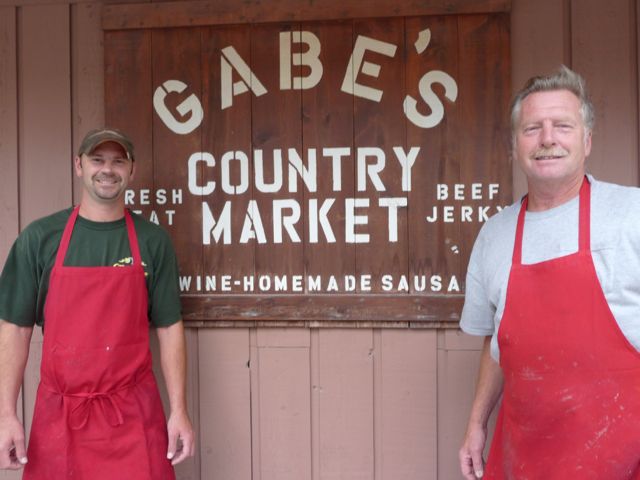
The father-and-son Gabourie team of Mike and Mike keeps Gabe’s Country Market customers happy, whether they’re shopping in the Maple City store the family has owned for 21 years or ordering their jerky online at www.gabesmarket.com.
“This year we’ve had a phenomenal summer,” Mike Jr. said, explaining that in July they made a 50-lb batch of jerky “every single day” and almost ran out of the popular snack food even at that volume.
“It’s more important about it being fresh,” he explained, adding that they could probably make 300 lbs. on one day, rather than 50 lbs. every day, so they wouldn’t sell out. “People actually appreciate the fact that’s it’s fresh every day. We have a ton of repeat business.”
Gabe’s uses two smokehouses, one gas-fired and one electric, and hickory chips for their naturally smoked flavors. Mike Jr. said they make their own seasonings, mix them by hand, and completely dry rub the meat, which is brined with brown sugar and salt. They offer beef, turkey, chicken and pork jerky in regular, hot peppered, extra spicy, teriyaki, Cajun and BBQ flavors. They also make venison jerky for hunters, from the hunters’ own deer. Jerky is sold by the piece at $14.99 per pound or in 1/4-lb vacuum-sealed packages at $15.49 per pound. (Gabe’s won Best Hot Dog in a popular vote of golfers at the Leelanau Peninsula Chamber of Commerce Golf Tournament held at the Leelanau Club in June.)
East side homemade jerky
“Master Smokesman” Roger Mikowski has been making jerky at the same location in Cedar for 30 years. His father formerly owned what is now known as Bunting’s Cedar Market. Some of the recipes Mikowski uses for smoking meat date back to 1908. The original wood smokehouse at the market resembled an oversized outhouse, according to Mikowski, and today’s concrete block version still uses the old-fashioned method of smoking with maple wood logs.
Mikowski learned to make jerky venison first for hunters, while processing their deer, then tried making a beef version for “people looking for something different.”
“By Lord, by golly, it went,” he said, and the original beef jerky flavor (with a bit of spiciness) is still the store’s most popular. One customer requested a sweeter, milder flavor (former Cedar Postmaster Tanis Lehmann) and that led to a number of spin offs. Among the nine or 10 flavors offered today are original and BBQ beef, teriyaki beef, regular and BBQ turkey, and sweet ham. All cost $16.75 per pound and are pre-packaged.
“I do have a little secret I use, a process my dad taught me that makes it not so tough — moist, more tender,” Mikowski said.
Bunting’s jerky sales are steady all year, but they sell about 50 lbs of jerky per week in summer.
“Like Grandma’s loaf of bread, you can’t duplicate that fresh, out-of-the-smokehouse taste,” Mikowski enthused.
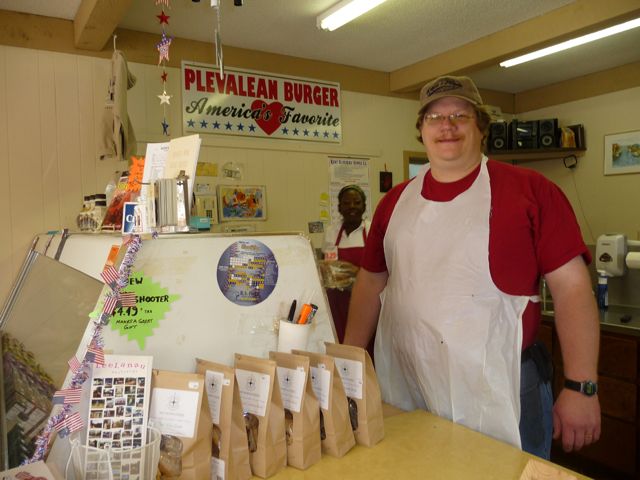 Tom Pleva, owner of Pleva’s Meat Market, a Cedar fixture for 60-plus years, said he always used the jerky made by Pleva’s as the standard by which to compare all others.
“Long as I can remember, I used to get it as a kid every time we visited,” said Pleva, who grew up downstate. “It’s one reason I wanted to buy the business.” (Pleva bought the meat market from his cousin, Ray Pleva, eight years ago.)
He said his regular jerky is sweeter (he uses sugar) than most, though he uses a little pepper and, of course, salt to cure the meat before smoking it over maple and cherry wood.
“It’s a very basic brine,” he said of the original version. “The flavor comes from the magic in the smokehouse. No flavorings are added.”
Three kinds of meat are offered: beef, turkey and chicken. Cajun, jerky and spiced versions are available, in addition to the “regular” flavor. All cost $19.99 per pound and are sold in bulk from the case.
“You could say it’s expensive, but compared to brand X, cheap stuff at a party store, you’re probably paying $25 a pound,” he explained. “Quality is a key factor. It’s probably one of our most labor-intensive (products).”
Local jerky offers a burst of flavor for bicyclists, boaters, hikers and paddlers wanting a low-fat snack in summer. For skiers, snowmobilers and ice fishermen, it’s a nourishing nosh that can warm you from the inside out. The only question that’s nagging us is: Where’s the whitefish and salmon jerky?