
Are Pollutants Entering Glen Lake?
 From staff reports
Sun contributor
When most people think of Glen Lake, they think of pristine, beautiful, colorful water nestled in the hills adjacent to Sleeping Bear Bay and the unique setting that inspires us all. So, are they right in thinking this? Is Glen Lake really the unspoiled gem of the Midwest? If it is polluted, how would you know? Can you tell just by looking at it? Can’t we infer from the crystal clear water, sandy bottom, and gorgeous color all add up in one’s mind as being a lake with high water quality?
Fortunately, the answers to these questions are found in part to a long time scientific study that the Glen Lake Association has conducted for more than 25 years running. Each year, the water quality committee, under the supervision of Rob Karner, the Glen Lake Association’s watershed biologist, performs a “Cladophora Survey”. The purpose of this survey is to pinpoint along the shoreline where excess nutrients like phosphorous and nitrogen (pollutants) are entering the lake. These two pollutants come mainly from septic and or lawn fertilizers but can enter the lake naturally. These pollutants stimulate the growth of a harmless but an indicator species of algae called Cladophora. Cladophora acts much like the canary in the coalmines. It indicates whether the coal mine air is safe to breathe. It is an algae that can only attach to rocks, logs, and other stationary objects. It cannot grow in loose sand.
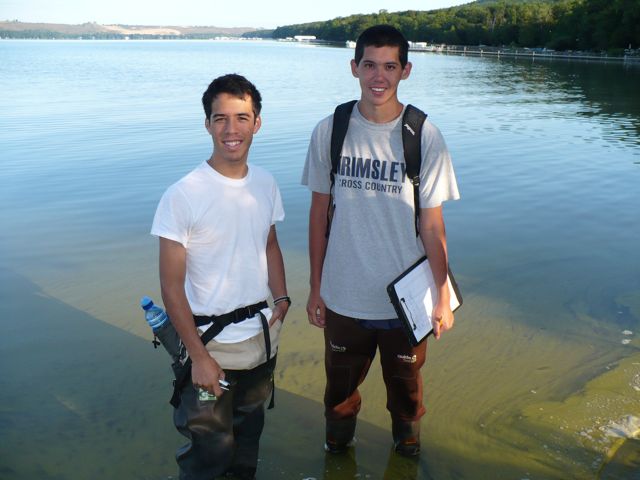
For over 25 years, the shoreline of Glen Lake (both Little Glen and Big Glen) has been observed during the summer by two researchers (see photo) who walk along the shore in hip boots. They are equipped with a GPS, data sheets, and a measuring device. As they walk the shore and encounter live Cladophora, they mark it‘s location on the GPS and measure the dimensions of the algae – length and width of the algae growth and length of the algal filaments. From the collected shoreline data, a map of Glen Lake is constructed from the GPS coordinates illustrating where the “hot spots” are found. The number of Cladophora sightings along with how large the area is, helps answer the question “How polluted is Glen Lake?” If the data shows large number of Cladophora positions around the shore along with large dimensions, then more pollutants are entering the lake than is desirable. The degree at which we can claim that Glen Lake is polluted is an arbitrary one. In general, Glen Lake IS a pristine lake and does maintain very high water quality. That is very reassuring.
However, claiming Glen Lake water quality as being pristine is like claiming we are the world champion in 2010. Who will be the world champion next year and subsequent years after that? We need to put our time, energy, and resources into maintaining Glen Lake’s water quality every day. If we let our guard down and neglect how pollutants enter the lake, then Glen Lake water quality will deteriorate. In short, we will no longer be champions.
If you want to know how you can do your part in keeping Glen Lake water quality high, then contact the Glen Lake Association, P.O. Box 245, Glen Arbor, MI and request a manual that will assist you in how to be a good steward of the watershed. You can also contact Karner at rkarner@leelanau.org or (231) 334-5831. If you would like to see the map that summarizes what shoreline has “hot spots”, he will send you a copy. For more information about Glen Lake Association, visit us at www.glenlakeassociation.org.