
A Glen Lake Laker hangs up his spikes after a career on German baseball diamonds

By Jacob Wheeler
Sun editor
This spring, for the first time since he moved to Munich 15 years ago, Maple City native Steve Walker is not hurling fastballs from the pitcher’s mound or smacking line drives from the batter’s box. As so often happens when we reach our mid-30s, baseball, or the activity we love most, takes a backseat to fatherhood and family life.
Walker continues to support his Munich Caribes professional club this year as a general manager who helps build the team roster and support local youth development. But the one-time sandlot standout at Glen Lake High School and the star pitcher and shortstop in Germany’s Second Bundesliga also has his eye on t-ball, where he plans to coach his 4-year-old daughter Selma next year.
As Walker views his baseball career in the rearview mirror, one thinks of the lyrics from the Iowa folk singer Greg Brown’s song “Laughing River”: “So goodbye to the bus, goodbye to payin’ dues / Goodbye to the cheers and goodbye to the boos / I’m trading in this old bat for a fishing pole / Gonna let the Laughing River flow right into my soul.”
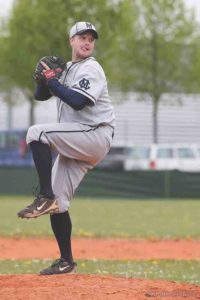 A tremendous career that started with t-ball at Myles Kimmerly Park in Maple City and little league at the Empire ballfields led Walker to Glen Lake, where he served as batboy and then scorekeeper as a middle schooler, before starring at shortstop and second base, and often coming in to close games on the mound. Walker batted a whopping .480 during his high school career, which landed him in the top 40 all-time in Michigan (that’s a safe hit almost every other at bat!). The Lakers made it to the state semi-finals during Walker’s junior year; he was named All State during his senior year.
He went on to Wayne State to play Division 2 college baseball, but an injury his sophomore year ended any dreams of making it to the Major Leagues. Walker focused on academics. His friendship with Tobias Luhmer, who had been an exchange student at Glen Lake and kicker on the football team, sparked his interest in the German language, and he spent his junior year abroad in Munich, working toward a Bachelor’s degree in Business Administration with a minor in German.
Smitten with the Bavarian city, Walker moved back after finishing his studies to work for Munich Re, one of the world’s largest risk management and financial services companies. (He’s a business developer of innovative, technology and data-driven risk management business models in the industrial and manufacturing industries.) In the land of Fussball, Biergartens and BMW, baseball called once again.
Walker twice turned down opportunities to play in the First Bundesliga, where many former U.S. college players land, and instead signed on in 2007 with the Munich “Caribes,” which had been founded a decade before by Venezuelans and other Caribbeans.
“I was immediately integrated into the Caribbean family culture and loved the experience of being surrounded by over 20 different nationalities within the club,” he said. “Although on another continent, it reminded me of the family support and loving atmosphere back at home around the ballpark.”
With Walker pitching and once again playing the middle infield positions, the Caribes played well and advanced through Germany’s leagues all the way into the Second Bundesliga, where they won four championships over the next 15 years. He won several batting titles and best-pitcher awards. But as Walker and other teammates were starting families, they turned down the honor and commitment of the team advancing to the First Bundesliga.
Baseball was in some ways the same game in Germany as it was back in the United States. Three strikes, four balls, 90 feet between the bases, and nine innings. But for Walker, the nuances of the way baseball was played abroad could be hilarious and, at times, frustrating.
Most of the Caribes spoke Spanish during the game, and one teammate was a 50-year-old Mexican who claimed he had once played professionally in Japan and who talked to the hitters the entire game and sometimes told them what pitch he was about to throw.
I also played briefly in the Second Bundesliga in 1999 in Freiburg—a little university town nestled in the Black Forest in southwestern Germany. For half a season I caught a pitcher from the Dominican Republic who stood no more 5-feet-6 but was incredibly effective at getting hitters out. Mario’s secret was that after delivering the ball toward home plate, he would bark like a dog at the hitter—just as they were beginning to swing. The German umpires implored us to cut it out, but I didn’t speak Spanish at the time, so I couldn’t communicate with Mario, beyond using my fingers to signal uno for fastball and dos for breaking ball. The barking, the strikeouts, and the weakly hit groundballs continued.
Germans are famous for their precision and analysis, and Walker once encountered a baseball novice and aspiring coach who insisted that the Caribes should practice bloop hits in batting practice, “because it’s just such an obvious place to hit the ball since the defense isn’t standing there,” he recalled. “On the flip side, he said we should also change our defensive alignment to cover the open areas where the opposing team has been practicing their bloop hitting.”
“I had to very nicely decline his offer to help us practice them the next day.”
Sometimes that unflinching logic bumped up against important traditions that are part of baseball’s code of honor. More than once Walker felt disrespected by batters peeking back at the catcher to steal signs and learn which pitch was coming, or runners stealing bases even though their team lead by more than 10 runs.
“I had a lot of pride in the integrity of the game of baseball and too may expectations on how it is ‘supposed’ to be played,” he said. “This led to some culture shock on the baseball field as I often interpreted the Germans’ behavior as disrespecting the game or me, personally. This often led to some verbal confrontations.
“It was a valuable learning experience to start letting go of things I cannot control around me, and especially how I think others should behave.”
With his spikes now retired after a 15-year career in Germany, Walker can impart those life lessons to his daughter on the t-ball diamond.

