Glen Arbor Sun
May 17, 2012
Stories About Us Contact Us Advertising Area Links Community Calendar Subscriptions & Email Updates Home

To pave or not to pave the Sleeping Bear Heritage Trail?
published July 15, 2010

Some citizens prefer compact earth or crushed limestone to asphalt

By Jacob Wheeler

Sun editor

With at least one fundraising meeting under the belt, and checks already committed by local private-sector philanthropists, the Sleeping Bear Heritage Trail appears to be on a momentous course for success. According to Tom Ulrich, Deputy Superintendent of the Sleeping Bear Dunes National Lakeshore (the local branch of the National Park Service), construction could begin as early as next year.

This multi-use, biker-oriented trail within the Lakeshore will run roughly parallel to state highways M-22 and M-109 near the Dune Climb, and will one day stretch from Manning Road, south of Empire on the Leelanau-Benzie county line, to the Lakeshore’s northeastern border beyond Port Oneida. It will increase the region’s visibility as a biker destination and almost certainly bring more visitors into the Park.

Traverse Area Recreation and Transport (TART), which heads the fundraising effort, envisions that, one day, two-wheelers will be able to pedal from Traverse City to Northport and around the perimeter of Leelanau County, clear to Frankfort and the existing Betsie Valley Trail. Around nearly every turn, this grand idea has been greeted with open arms.

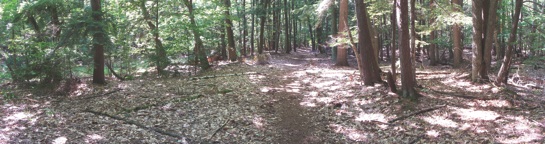
But the trail’s specifics — 10 feet wide with two-foot buffers on either side — and a push by TART and the Lakeshore to pave its surfaces (as required by the Americans with Disabilities Act) has some local residents worried that the Sleeping Bear Heritage Trail will be not a trail, but a mini highway through the National Park.

Of particular concern is Segment Five of the proposed trail, which would divert west of M-109 near the Dune Climb and follow an historic narrow gauge railroad toward Glen Haven before running south of 109 (Harbor Highway) toward Glen Arbor, at the base of Alligator Hill. Segment Five may be the first portion of the trail constructed.

The Glen Arbor Sun met with a trio of citizens last week who, though supporters of the trail, oppose the exclusive use of asphalt and believe that a 14-foot-wide, paved trail is incompatible with the aesthetics of the National Lakeshore. Cookie and Becky Thatcher and Nancy Mueller worry that our precious Park is ceding land to TART, and bowing to the regulations of the Michigan Department of Transportation (MDOT, who would eventually install the asphalt), which they call “a highway service,” not a trail designer.

“The Park is giving TART free access to go in and build trails,” says Mueller. “This is a piece of land that went through national legislation to protect it. And yet TART is treating this like an extension of the Traverse City trail system. People come here to get away from pavement and sidewalks and typical suburban parks. Certain areas of our Park are not to be paved over.”

Mueller adds that Segment Five near Alligator Hill is zoned “recreation”. According to the Park’s General Management Plan, any such natural overall alterations must be designed to blend in with the rustic, natural landscape.

“I don’t believe that asphalt is rustic or unobtrusive. And yet this is the Park’s plan — a 14-foot, paved bicycle path.”

The width of the trail will require the removal of trees that would be unnecessary if it were more narrow, and rustic. Mueller fears that a wider trail means a straighter trail, and a faster trail. “When you take a two-lane and make it a four-lane road, people go a lot faster.”

Debates like these, between recreation and preservation, represent an age-old discussion within the National Park, says Tom Ulrich. We see these two camps square off every time the Lakeshore faces major decisions, be they a General Management Plan, parking lots at Glen Haven or North Bar Lake, or the scenic outlook at Pierce Stocking Drive.

“We always ask ourselves, ‘have we designed a trail that provides immense benefit without having a significant (environmental) impact?’” explains Ulrich. “The goal of this trail is to provide maximum utility for many users — hikers, rollerbladers, wheelchairs and both wide- and thin-tired bikes. The best way to do that is with a hard-surface trail.”

The Park’s Environmental Assessment revealed that pavement would have a minimal environmental impact on ecosystems such as those in Segment Five, which may also include a boardwalk over certain wetlands.

Cookie Thatcher believes that compact earth or crushed limestone would suffice for a trail surface that could still accommodate most bikes and non-motorized vehicles, and would prove more appealing to hikers who don’t favor pavement. She wants the Park to consider trying compact earth or crushed limestone first, for two or three years. If that doesn’t work, then pave it.

But Ulrich disagrees. Crushed limestone is not good for rainwater runoff, he says, whereas a paved surface would have a longer lifespan and serves a greater number of people. Ulrich has studied crushed limestone bike trails elsewhere in the United States, particularly one in Kansas, which, according to online commentary, hasn’t been kind on road bikes.

“Most narrow-tired bikers say they can’t ride there. They get too many flats. In fact, some former crushed limestone trails are redoing them. Earth trails are primarily used for mountain bikes.”

To Nancy Mueller, the Park and TART’s push for paved trails proves that the Sleeping Bear Heritage Trail is a bike trail first and a multi-use trail second.

Becky Thatcher wonders to what degree the trail’s private financing has forced the Park’s hand. TART heads the fundraising, several prominent local businessmen have already pledged their support, and the federal government has offered up to $5 million in matching funds. In short, none of the money required to build this trail will come from the Park’s coffers.

“Are they trying to cooperate so much with MDOT and TART that they’re forgetting their own citizens who use the Park?” Becky asks.

Cookie Thatcher and Mueller, both of whom are certified trail masters, favor a packed earth trail that can be maintained by volunteers. Cookie alludes to popular natural trails in both Missouri and Lake Tahoe, Nev., which are used by bikers, hikers, and animals from horses to donkeys. She favors investing in a $100,000 machine that carves and compacts dirt into a two-foot wide path.

Some of the natural trails in the Sleeping Bear Dunes National Lakeshore, Cookie says, have been around since the loggers, and the Native Americans before them, tamped down by feet and hooves. “Not one piece of equipment has ever been back there.”

In addition, Cookie worries that this trail through hilly country couldn’t possibly conform to the maximum 10-percent grade required for wheelchairs by the Americans with Disabilities Act.

“There isn’t anybody in a wheelchair who could get up the hill between Empire and Glen Arbor. They’d have to add switchbacks, which would be 14-feet wide and paved. That might mean paving the whole hill!”

Becky Thatcher says she welcomes the Leelanau County-wide trail with open arms, but only if it’s done in the right manner. She proposes building a packed earth surface for Segment Five between Glen Arbor and Dune Climb — the first phase that will be launched.

“It would serve as an example to people of how to install a trail that’s sensitive to the environment, and it could be done by volunteers. We don’t just have to pave it because it’s convenient and gives us a bike path. Instead we can teach kids how to adapt to the land and conserve it.”

Stay tuned for more perspectives on the Sleeping Bear Heritage Trail in future editions of the Glen Arbor Sun, including interviews with local business owners who are already writing checks, and inside looks at the pros and cons of similar trails elsewhere in the United States.

41 Responses to “To pave or not to pave the Sleeping Bear Heritage Trail?”

  1. Molly says:

    Leelanau County has some of the best cyling in the country, and anyone who is serious enough to ride the perimeter of Leelanau Peninsula will do it on the roads. Plus I’d rather not increase my chances of plowing into a deer at 20mph by being in the middle of the woods.

    I’m personally against paving, but like the idea of a compacted trail. Then at least mountain bikers in this area would have some more options, us roadies have plenty.

    Thanks for the article, Jacob.

  2. Jon King says:

    Unfortunately I agree that a 14′ wide trail would have to much presence in the “wilderness of the park”. We have trails all over the South East Grand Rapids area that are half that width and have met with great success. I’m concerned that the Sleeping Bear experience is become to predictable and zip lock bag like.

  3. David L. says:

    I think it’s a bold move and I’m all for it. I understand local concerns but overall I think this will be of great benefit to anyone who lives in the area along with those who visit-

  4. Bill says:

    Frankly, I am not for the trail at all, but to pave it with asphalt (which tends to crumble at the edges and deteriorate badly after ten years) would be a sin. Remember, the folks who are proposing this scheme are the same brain surgeons who proposed the “tunnel at the overlook” fiasco.

    Theodore Roosevelt said of the Grand Canyon: “Leave it as it is. You cannot improve on it. The ages have been at work on it, and man can only mar it.”

    Those in charge of our local gift of God would do well to heed President Roosevelt’s advice.

  5. Jim Lively says:

    Let’s keep the facts straight – it’s a 10′ paved trail, not 14′, which is exactly one road lane of pavement – which I have not heard much opposition to elsewhere in the county.

    Let’s remember that Sleeping Bear Dunes National Lakeshore is a National Lakeshore – to be enjoyed by people from all over the world. It is not a Leelanau County Park. Leelanau county residents need to remember that our perspective is skewed by living here. Consider how you would approach a national park anywhere else: as a visitor, you would absolutely appreciate the opportunity to ride a bike – or take a stroller, roller blades, etc. – through the woods near the road, not be forced to ride on the road.

    Yes, “we” don’t need another paved trail, because we know all the great places to ride. But visitors don’t know of any of these trails. And please talk to the trail planners about how the impact to tree canopy and wildlife has been minimized by following already-impacted areas. This is not a massive impact to the lakeshore, but a tremendous benefit to visitors – and residents alike.

  6. Ronda Reems says:

    As the article points to trails in Missouri as an example of chipped/compact services, I am familiar enough with those Missouri trails to offer an opinion on this topic.

    The Katy trail is not paved and utilizes a compact format for bike riding, walking, hiking. I have observed cyclists, both dirt and road, on the trail. It is a very lengthy trail, traversing the width of the State, and is widely used and enjoyed.

    On the other hand, a recent joint venture between a local cyclist group and the US Corp of Engineers, paved a wide (10-12 feet) trail abutting Smithville Lake (north of Kansas City). I have been there many times, too, and it appears the trail is overly wide because there is rarely a steady stream of “traffic” going both ways. Additionally, because the topography causes a few steep inclines, my clientele who need mobility assistance tell me they never venture to that trail because regardless of the pavement, they simply are not willing to do the hills. Those using mobility devices have found more flat places on the other side near the trailhead where they can view the lake. In addition, the “dirt” bike crowd never uses the paved trail and they have developed their own dirt trails off in the woods, which allows them to ride in the conditions they desire (narrow paths, short steep hills and jumps).

    I applaud the efforts of those who care enough about the park lands to ensure the park remains in its most natural state. I recently was on the Empire Bluff Trail and witnessed many adults and children climbing down the face of the bluff – all admitting they were aware this was prohibited – (they saw the signs telling them not to climb down to the beach). And they simply didn’t care. One family admitted they do it every time they visit the area a few times a year. The conduct of these individuals is inexcusable – but, probably, not likely to change. Those that love the park, must be vigilant in protecting it as much as possible.

    As I was not present for the meeting referenced in the article, I feel sure I do not have all the relevant data. So I do not undertand the necessity for a trail that is 10′ wide, nor why it can’t be constructed of natuarl material in segments and paved in other segments. I also agree that in some places the “paved” portions could actually utilize the exiisting roadways. We road in Denmark a few years ago, and those trails utilized a combination of all three: compacted dirt, existing roadways, and newer built paved segments.

  7. Marilyn Miller says:

    To all those who might be considering contributing to the bike trail fundraising effort, I urge you to think: Is this really how you want to be remembered, contributing to a controversial project that constructs a permanent roadway through the entire length of a national park, a project that is both unprecedented in the entire National Park System and unnecessary in this region of Michigan as there are many excellent biking opportunities already existing here?
    Before you write that check, go to http://www.thepetitionsite.com/1/dont-pave-the-forest (or search Don’t Pave the Forest) and read the many sincere and well reasoned comments of over 500 concerned people who have signed the Don’t Pave the Forest online petition. Go back through the pages of signatures. You may recognize some of your neighbors.

  8. Patricia Widmayer says:

    In my view, the Sleeping Bear Heritage Trail presents an invaluable opportunity for greater, responsible access to the beauty, diverse environment, and habitat that is the Sleeping Bear Dunes National Lake Shore and Leelanau County. In your article, you raised the concerns of some residents who would prefer to see the trail constructed as a narrow, natural path. I appreciate their concerns, but it is far more responsible to create a trail that permits more of our fellow citizens, including those who are physically challenged, to share the wonders of the park. The Trail should be constructed as a wider asphalt trail for all ages and abilities to walk, run, bike, explore – or just be still and take in all that is around them. So many are unable to maneuver a narrow, often uneven path. How wrong to decide that only the most able-bodied are welcome.

  9. Missy Luyk says:

    The Sleeping Bear Heritage Trail is so much more than ‘just a trail.’ It will wind through historical areas, past scenic vistas, and offer a true connection to nature and the environment. Trail users will be able to experience the park in a whole new way. It’s a legacy project that will offer a safe and special way to explore the park for people of ALL abilities.

    The facts in this article are not accurate. It’s not going to be a 14-foot wide trail. It’s 10 feet, with a 2-foot grassy area on either side. Marilyn Miller’s “Don’t Pave the Forest” campaign is filled with misinformation. Please talk to someone at TART or at the Park before signing that poll.

    Think of the future… 20 years from now, we’ll wonder how we got along before the Sleeping Bear Heritage Trail. The trail will connect major park attractions and local communities- Empire, Pierce Stocking Scenic Drive, Dune Climb, Glen Haven Historic Village, D.H. Day Campground, Glen Arbor, Port Oneida Historic District and Good Harbor Beach. The trail alignment utilizes the highway right-of-way, existing trails, roads, and former railroads within the park. I envision many future environmental education programs, cultural/historical programs and events that could take place.

    There’s not a doubt in my mind that this is a great project that is worthy of the community’s support. This trail will make an already special place even more so.

    Missy Luyk, TART Trails
    231-941-4300

  10. Marilyn Miller says:

    Yes, the trail will be 10 feet wide — at a MINIMUM — with 2 foot shoulders. Whether the shoulders are crushed rock, as I was told last summer by NPS staff, or grass, it’s still a 14 foot wide paved, bulldozed, leveled roadway being constructed through the heart of Sleeping Bear Dunes National Lakeshore, through pristine mature forests, unique dune/swale wetlands, dune scrublands, along the very base of the sand dunes and, by its width, obliterating the historic narrow gauge railroad bed.

    Thinking of the future, what will be people’s reaction in 100 years? Twenty years is not really long-term thinking. For example, now, a hundred years after its construction, there is a growing movement to remove the Hetch Hetchy Dam in Yosemite National Park, which provides water for San Francisco and which John Muir vigorously opposed, to allow the Hetch Hetchy Valley to recover and be enjoyed as the second Yosemite Valley it was.
    Will our descendants want to remove old asphalt from Sleeping Bear to allow the land to be more natural? Will they wonder what we were thinking when we allowed the National Park Service to pave the forest, dune scrublands and wooded wetlands of the entire length of a national park for the enjoyment of essentially one user group, those seeking speed on wheels?

    Addressing ADA access, which Ms. Widmayer brings up, the trail does not need to be paved to be ADA accessible. Most national parks have ADA accessible trails going short distances to a viewpoint or interpretive feature; none have an ADA accessible trail through their entire length.

    Mr. Lively writes above something that I could have written — “that Sleeping Bear Dunes National Lakeshore is a National Lakeshore — to be enjoyed by people from all over the world. It is not a Leelanau County Park. Leelanau County residents need to remember that our perspective is skewed by living here.”

    Exactly. Sleeping Bear Dunes is a national park, one of only 58 national parks, seashores and lakeshores in the country, and the only national park in lower Michigan. It is not a county recreation area.
    This project, being so extensive — 27 miles, the whole length of the park — and so invasive, going away from existing road rights-of-way into pristine forests, dune scrublands, wooded wetlands, etc. — is unprecedented in the entire National Park Service. And with good reason. National parks exist to protect and preserve the lands entrusted to them, leaving them unimpaired for the enjoyment of future generations.

    To look at the big picture, let’s look at the project from both the national and regional perspectives. Nationally, one must keep in mind that SBDNL is a unit of the National Park Service. While each national park unit is unique, they must all adhere to the same principles. Nothing on the scale of this project has ever been done in a national park. From the regional perspective, we know that northwest Michigan is criss-crossed with many rail-to-trail conversion bike paths and many county and seasonal roads that are great for bicycling. So why should we let Sleeping Bear Dunes National Lakeshore be scarred forever by this unneeded, unprecedented project?

    Mr. Lively assumes that people visiting national parks want to “ride a bike, take a stroller, roller blades, etc.” Strange then that no other national park has such an extensive bike trail constructed through untouched parkland. The 2009 Visitor Survey conducted at Sleeping Bear Dunes National Lakeshore found that the most common site visited by visitor groups was the Dune Climb (61%), followed by the Pierce Stocking Scenic Drive (56%) and the beaches (42%). The most common and most important activities were walking, hiking, dune climbing and general sightseeing. Nowhere in the entire survey is bike riding mentioned as being a recreational activity that lacks trails.

    I would submit that those who oppose the bike trail in its current form are seeing the big picture, taking into account the national importance of Sleeping Bear Dunes and the regional recreational amenties already existing.

    Before you contribute to the fundraising campaign, Pathway to Sleeping Bear — which should more accurately be called Speedway Through Sleeping Bear — know the facts. Read the comments on the online Don’t Pave the Forest petition — http://www.thepetitionsite.com/1/dont-pave-the-forest.
    Don’t let the Sleeping Bear of Sleeping Bear Dunes National Lakeshore become a Weeping Bear, as she surely will if this project goes forward in its current form.

  11. Marilyn Miller says:

    Just to be as precise as possible, the trail will be 10 feet wide at a MINIMUM, with a surface of either asphalt or crushed limestone, and with 2 foot shoulders of either crushed limestone or perhaps grass. This is 14 feet MINIMUM of graded, leveled, bulldozed roadway construction going through the interior heart of Sleeping Bear Dunes National Lakeshore.
    According to the Environmental Assessment for the project (page 122), 60% of the total length (26.23 miles) of the trail will be asphalt, 17% will be crushed limestone, 2% will be boardwalk, 18% will be on-road bike lanes, and 2% existing gravel roads. (Percentages are rounded.)
    For the first segment to be constructed (Segment 5, which goes from the Dune Cimb to Glen Arbor) 94% will be asphalt and 6% limestone. There are no on-road, boardwalk or existing gravel road options used in Segment 5, according to the Environmental Assessment. This means that for this very important segment, linking the Dune Climb, going along the base of the dunes, along the historic narrow gauge railroad bed, through Glen Haven, through D. H. Day Campground, across M-109 and through the forested ridge/swale complex at the base of Alligator Hill, the forest will be paved with asphalt.

    Asphalt is a mixture of gravel and sand with crude oil derivatives. It is not a renewable resource; it is not “green.” In fact, asphalt fumes are known toxins. According to the Environmental Protection Agency, “Asphalt processing and asphalt roofing manufacturing facilities are major sources of hazardous air pollutants such as formaldehyde, hexane, phenol, polycyclic organic matter, and toluene. Exposure to these air toxics may cause cancer, central nervous system problems, liver damage, respiratory problems and skin irritation.”

    It’s not just the manufacturing process of asphalt that releases these toxins. Large amounts of harmful “fugitive emissions” are released as the asphalt is moved around in trucks and conveyor belts and is stored in stockpiles, according to a study by Dr. R. Nadkarni. We all know this from the smell of asphalt as you drive through a construction zone.

    Now I noticed a nice article about how Bob Sutherland is leading Cherry Republic in a “green” direction, which is commendable. Cherry Republic is one of the biggest financial supporters of the paved bike trail. How can a company that is striving to be green and is touting itself as being green support asphalt, a known pollutant and nonrenewable resource, for the surface of this trail going through a national park?

    The Environmental Assessment, page 75, says that “Trail construction activities have the potential to impact wetlands and water quality, which may result in pollution of wetlands and water bodies with petroleum products and other substances. This pollution of the wetlands can lead to loss of both structure and function over time, and thus further reduced water quality.”

    The 2009 Visitor Survey at the Lakeshore found that “the resources/attributes most commonly rated ‘very important’ or ‘important’ were clean water (96%) and clean air (95%).”
    The National Lakeshore would do well to respect the opinions of their visitors on the importance of clean water and clean air in the Lakeshore and to eliminate polluting asphalt for the entirety of the trail.

  12. Patricia Widmayer says:

    What a shame that Ms. Miller believes that “short distances to a viewpoint or interpretive feature” are what those with limited mobility should be expected to accept as access to the national parks. Just because other national parks don’t have “ADA accessible trails through their entire length” is an unconscionable rationale for arguing that the Sleeping Bear Dunes National LakeShore should not have a feature that is much more welcoming to everyone regardless of physical ability. Addressing the needs of our fellow citizens in a way that is sensitive the park — which I believe the current plan is — offers such an opportunity. From toddlers to the elderly seeking to walk in clean air and not along the risky shoulder of a county road, to the teen using a wheelchair or an adult with an assistive walking device that cannot be maneuvered on gravel or sand, we must make it possible for them to see and experience far more than a “short distance to a viewpoint or interpretive feature.” It is both responsive to the Americans with Disabilities Act and the right thing to do.

  13. Marilyn Miller says:

    A hard-packed crushed limestone surface, or even hard-packed dirt, meets ADA requirements for accessibility. The trail does not have to be paved with asphalt.
    Since, according to the 2009 Visitor Survey, most visitors to the Lakeshore went to the Dune Climb (61%), followed by the Pierce Stocking Scenic Drive (56%) and the beaches (42%), perhaps the Lakeshore should spend its limited resources on enhancing access to its most popular features rather than provding complete access to its “backcountry.” This is what all other national parks do.

    While I love everything about the northern environment so much that I could never call it monotonous, that is exactly what noted wetlands consultant Warren Studley described it as in his report of September 28, 2009. Let me quote Mr. Studley:

  14. Marilyn Miller says:

    Quoting wetlands consultant Warren Studley,
    “A very strong case has been made for the 10′ wide hard surfaced trail for use by people using wheel chairs, walkers, canes and similar equipment. Based upon extensive use of wheel chairs and walkers by a member of my immediate family, I find the proposed NPS Alligator Hill Trail to be rather monotonous, providing little special scenic appeal or unusual visual excitement for the majority of individuals visiting the proposed trail site. The reasons are as follows:
    “The entire Alligator Hill Trail is over a relatively flat, low lying ridge & swale topography with a unvarying composition of northern MI hardwood species of varying sizes. Both natural features soon become monotonous as both occur in abundance from Empire to north of the Little Traverse Lake areas. This single combination of landscape form and vegetative cover type comprises hundreds of acres of a single extensive natural feature type with little or minimal ‘edge affect’ associated and occurring with several different natural habitat types occurring in close proximity.
    “Alligator Hill itself as a physical feature is mentioned/featured but is not closely and easily accessible by those requiring handicapped equipment and care providers. The Alligator Hill will not be accessible because of the extremely steep slopes facing the northwest. The single wetland body is monotonous to the usual visitor as it has no outstanding visual or scenic feature. It is seldom use by waterfowl because of the closed forest canopy on all sides. Many wildlife species are nocturnal and shy away from individuals reducing time of viewing.
    “The proposed Alligator Hill Trail has no water features in close proximity such as a small free flowing stream, a pond of significant size to create alternative uses by people and/or wildlife.”

    Strong words, I know. Personally I could never call the beautiful forests of Sleeping Bear Dunes National Lakeshore monotonous. In fact, I was shocked when I read this part of Mr. Studley’s report. Yet he is an environmental expert and happens to be a caregiver for a disabled family member. I respect his opinion.

    According to the Visitor Survey, “Of visitor groups that spent less than 24 hours visiting the park, 29% spent three to four hours. For those who visited for more than one day, 55% spent two to three days. The average length of stay was 39.5 hours, or 1.6 days.” That’s not a lot of time left over, after taking in the highlights of the Dune Climb, Pierce Stocking Drive and beaches, for a bike ride, especially when considering other competing park activities, such as a trip to South Manitou, a hike to Empire Bluffs or Pyramid Point, a visit to the Maritime Museum and the village of Glen Haven, and non-park activities, such as kayaking the Crystal River, jet-ski or boat rental, fishing, shopping, dining, etc. And remember that there were no complaints of inadequate bicycle opportunities in the Visitor Survey.

    “Eight percent of visitor groups reported physical conditions that made it difficult to access or participate in park activities or services.” Certainly the park can do a better job of making its most important features, the ones visitors want to see, more accessible. But a 27 mile paved roadway through the “backcountry” of Sleeping Bear Dunes National Lakeshore is not the answer.

    It’s clear to me that the real beneficiaries of the paved trail will be local bicyclists and bicycle clubs from nearby areas and, of course, local businesses that will be able to promote this bike trail as the “premier” bike trail in the country. There is nothing wrong with the Heritage Trail concept of having a bike trail around the Leelanau Peninsula. There is nothing wrong with businesses using that as a selling point to get tourists to come to the area. It just doesn’t belong in a national park.

    Every community in the Great Lakes region wants to have a “premier” bike trail to promote itself as a destination. But this small corner of Leelanau County is already a nationally known and internationally known destination because of Sleeping Bear Dunes National Lakeshore. The National Lakeshore should adhere to basic National Park Service principles, followed by every other national park, of making the most important visitor sites more accessible and preserving and protecting the backcountry, leaving it unimpaired for future generations to enjoy.

  15. Nancy Mueller says:

    The Sleeping Bear National Lakeshore is NOT an extension of Traverse City TART trails. This Lakeshore is not just a chunk of land where asphalt trails can be put in. This area is a protected Federal Park.
    The Lakeshore leaders have let us down by caving in to the Bike groups and allowing asphalt in the Park.
    In the FONSI report (Findings of no significant impact) released in March 2009 no mention was made or suggested that asphalt was being considered as the primary surface material. Of course asphalt will have some impact on the environment as it is petroleum based. How accurate is that FONSI report if it did not consider the impact of asphalt?
    Also the public input for this Heritage trail was held in the months of March when people are not up here. I believe that was done intentionally. The Park acknowledges that the highest months of usage in the park are June through August. Wouldn’t it be logical to have had public input meetings in those summer months?
    In addition, there has never been a public input meeting on determining trail surface. Why is that? Patty O’Donnell tells me that the trail surface is being decided by MDOT. This agency build roads and highways so more than likely they are going to decide on asphalt because that is what they are-road builders. Why is MDOT deciding the trail surface?
    Where will they draw the line at putting in asphalt “roadways” through the park? What is next? This is not a heritage trail but a road.

  16. Nancy Mueller says:

    The fundraising group for the bike trail has named themselves “Pathways to Sleeping Bear”. This is a misnomer because a paved road is not a pathway. A paved fourteen foot wide road just is not a path.
    Be informed before you give your money to this project. What is going to make the Lakeshore different than any other city/suburban park with paved bike trails? The managers of this fundraiser want this project to sound like a path. I have not seen a “path” that is the size of a road.

  17. Nancy Mueller says:

    The General Management Plan of the National Lakeshore divides the Park in to four zones. Section five of the trail is designated as a Recreation Zone surrounded by the Experience Nature zone. The Recreation Zone’s character is “natural overall; alterations are designed to blend with the natural landscape.” How natural is asphalt? How does asphalt blend in with the natural landscape?

    “Generally, the experience is rustic and there is a sense of being in a natural landscape.” Asphalt is not rustic. A natural landscape does not include asphalt.

    “Developments are unobtrusive and fit in with the natural environment.” Unobtrusive means not attracting attention and not conspicuous. Asphalt is obviously not natural.

    The stated purpose on page 11 of the General Management Plan is written as follows: “To preserve outstanding natural features, including forests, beaches, dune formations, and ancient glacial phenomena in their natural settings and protect them from developments and uses that would destroy the scenic beauty and natural character of the area, for the benefit, inspiration, education, recreation, and enjoyment of the public.” This specifically says the Lakeshore will preserve these areas in their natural settings and protect them from developments. Asphalt is a “development” that does not stay in keeping with the stated purpose of the National Lakeshore.

    Let’s at least give a natural trail surface a try before we pave paradise with hot asphalt. There are other options to consider for trail surface other than asphalt.

  18. Sharon says:

    I am all for the trail. Yes, we do need a paved trail for all to use. Leelanau County is a wonderful place to ride- but the roads are not safe in the summer with all the traffic. There are few roads that have good shoulders – most do not have shoulders at all.
    I believe the trail will be used by many and will be a great asset to our county.

  19. John Janulis says:

    I do not think it is the responsibility of the National Park Service to resolve the bike safety issues along the highways/roads in Glen Arbor. The NPS is a federal agency. If the existing roads provide an unsafe surface to ride bikes, the local and municipal government should be the first to respond. It is my belief that the growth of businesses-many of whom are financially in support of the trail-are to blame for the increased traffic and unsafe conditions along the roads. The proposed trail does nothing to bypass this unsafe area; it is slated to end by the Christian Science Church. Bikers would still have to continue through Glen Arbor on M-22 and M-109 amid the congestion mentioned.

  20. Marilyn Miller says:

    Comments like Sharon’s above just reinforce my point that the paved trail will primarily benefit local bicyclists. If some roads need wider shoulders for bike lanes, work with MDOT to get that done, but don’t treat lower Michigan’s only national park as if it’s Leelanau County’s local recreation area.

    And why does it have to be paved with polluting asphalt? Crushed limestone or hard-packed dirt is ADA accessible and bike friendly and would certainly give the hiker a more natural experience.

    And what happened to the multi-use designation for the trail? Now it’s baldly called a bike trail. If you logically group wheeled users (bicylists, skateboarders, rollerbladers, wheelchair users, etc.) together as one group, and add those on foot, at best it will be dual use. Multi-use by definition includes the three major trail user groups: hikers, bicyclists and equestrians. No sound reason has ever been given for excluding equestrians from the trail. The Environmental Assessment, page 4, says that the surface material should “accommodate all modes of non-motorized use, including a hardened surface for bicycling on all primary routes.”
    Since horses are definitely a non-motorized use, why have horses been excluded?

    Crushed limestone or hard-packed dirt would be a friendly surface material for all three major user groups.

  21. Jeff Ripple says:

    I am for the trail, but definitely not a paved version of it. From the various comments and what I’ve learned from trail experts, a hard packed dirt trail is the answer. I believe one of the primary missions of the National Park Service is to protect the natural character and ecology of the park. I don’t believe a wide paved trail lives up to that mission. A hard packed trail (not 10 or 14 feet wide) will allow hikers, wheelchairs, mountain bikes, strollers easy access and it sounds as if the maintenance issues will be minor. Touring cyclists will use the road anyway to maintain speed and not have to worry so much about pedestrians and other trail users, nor should other trail users want to worry about bikes doing 15-20mph on a trail. An appropriately sized hard-packed trail will serve park visitors while maintaining the rustic character and ecological integrity of the lakeshore.

  22. Pam Lincoln says:

    Thanks to the Sun for this informative article, and to those who have commented. I’m becoming informed because of you, and we NEED to know about this!

    I’m for a path..but NOT a road, and there is no question that a 14 foot total width of asphalt laid down 27 miles is a road. And that it goes not just along an existing roadway, but into natural areas that the Park and all National Parks are dedicated to preserving is unacceptable. Sleeping Bear Dunes National Lakeshore was created as a National Park by Congress and the wording states “the Congress finds that certain outstanding natural features, including forests, beaches, dune formations, and ancient glacial phenomena, exist along the mainland shore of Lake Michigan…and that such features ought to be preserved in their natural setting and protected from developments and uses which would destroy the scenic beauty and natural character of the area.” The Congress also directed that “the Secretary (of the Interior) shall administer and protect Sleeping Bear Dunes National Lakeshore in a manner which provides for recreational opportunities CONSISTEDN WITH THE MAXIMUM PROTECTION OF THE ENVIRONMENT WITHIN THE AREA.”
    The idea of a trail may be a fine one, but why asphalt??? It is both more environmentally damaging and more expensive than anything else. According to the Rails-to-Trails Conservancy which has an informative discussion online comparing various trail surfaces,It has this to say about asphalt: it “works well for bicycle commuter or inline skaters but typically can’t be used by equestrians, requires minor maintenance such as crack patching, but has a life expectancy of 7 to 15 years, is a flexible surface that requires used to remain pliable, and there is possible environmental contamination during construction.(Often used in urban areas, or near trailheads and access points. Average travel is 2=4 miles.) The COST of asphalt, according to Rails-to-trails, is $200K-$300K/mile….Crushed limestone, on the other hand as quoted in the same article “can hold up well under heavy use, complements asthetic of the natural landscape,and can accomodate nearly every trail user, if crushed and compacted properly (ezxcept inline skaters). As for the cost, it is $80K-$120K . Why is asphalt even considered, given these facts??

  23. keenan says:

    I have to say that I once signed the anti-path campaign however it was a little naive. There is NOWHERE to bike in or around Glen Arbor- that goes for mountain biking or road biking (for anyone who doesn’t want to ride MDOT’s sketchy fog lines and fake bike lanes). That should be clear.

    Glen Arbor is EXTREMELY auto-centric and having the option to bike to destinations within the park or village without having to subject yourself to M109 or M22 would be amazing.
    I assume most of the anti-trail advocates are of an older generation who do not bike or realize the benefit of having a safe, smooth, and scenic option for exercise or family outings. I remember I used to ride my bike 3 miles to my friends house on little glen nearly every day of the summer when I was a little kid. Would you let your child do that now—in the summertime? Could you imagine all those people who travel from the Homestead to Glen Arbor riding bikes rather than clogging the downtown with their cars?

    In terms of surfaces, no bikers will not want to use a crushed stone or dirt path unless it is meticulously maintained. If the park wants to provide a dirt trail that is a completely different topic. Some of us have been advocating for a dirt trail (mountain biking) for a very long time- if this is the solution the NPS is providing for those biking trail requests they have been completely misguided. This is going to facilitate MUCH more than a single track bike path.

    Someone above arguing that horses won’t be able to take the trail is completely tangential. Did you not know that they’ve always been allowed in the Park? The NPS is trying to provide a NEW program and honestly I know the 2 or 3 barns who do trail rides in the park and they’re not that often let alone even noticeable.

    Our township is something around 90% UN-DEVELOPABLE thanks to the park and our lakes. I bet 90% of the people against the trail haven’t seen half of it let alone are its active users—they’re simply for conservation. We have a LOT of conservation going on with in the SBDNL consider the conservation of our village’s vibrancy. The creation of this trail is going to provide a new reason for people to come visit and economically support our local businesses (and help facilitate the growth of our bicycle rental businesses). This is going to be a safe and regulated multipurpose trail providing 2 way traffic for all ages (hence the seemingly unfathomable width).

    Alright those are some thoughts- one other thing, I spoke to someone working on this a few weeks ago and they mentioned that the public discussion of this program ended a long long LONG time ago and that the project is going forward as planned. If people want to keep up on our local happenings I suggest they follow along with our local government and attend the meetings rather than waiting until they hear things through the grape vine.

    PS a “road” -such as M109 has a 66′ Right of Way. Not 14′

  24. [...] Hill/M-109 stretch in particular) has generated passionate opposition from some locals: see “To pave or not to pave the Sleeping Bear Heritage Trail?” in our July 15 edition, and numerous comments, both pro- and con- on our website, GlenArbor.com. [...]

  25. Tim Carpenter says:

    When I first read that the management plan included a trail from the north end of the park to the south I was very excited. My excitement was the prospect of a hiking and backpacking trail through the park that I could enjoy with my kids and get them a manageable three day backpacking and camping experience. The most recent Glen Arbor Sun article really got my ire with all the comments implying that biking in Leelanau County was just becoming too dangerous and because of that we need to pave a 27 mile trail through the park. What an appalling proposition. Leelanau County remains a bicycling mecca for hundreds of bikers. There are literally hundred of miles of scenic country roads for bikers to explore. It doesn’t really take that much effort for anyone to figure that out and many, many people do. People who think they need to stay on 22, 72, or 109 just are not making much of an effort.

    Most people are content to explore the park via the popular drive to attractions. Hardly any of them will bike or even take the existing hiking trails. For those of us who would like to get deeper into the forest and explore the park, having a trail that is really conducive for bikers only just doesn’t seem right. Can’t this trail be a hiking and mountain bike only trail with a much smaller footprint? That would be something to be proud off and something I’d be willing to contribute to. A bikers highway is a redundant amenity in this paradise area that still has plenty of wilderness to explore. Don’t sully that with another paved road.

  26. same issue/different place says:

    Thank you, Marilyn Miller and Nancy Mueller, for your dedication to preserving this natural area. I know it must reflect untold hours of research and advocacy.

    I live in another state but face the same issue, researching it is how I came upon this article. An asphalt “trail” is basically a road. People should know that trail-building has an immediate effect on the landscape, wide construction that slaughters trees and destroys vegetation, sometimes significant colonies of native plants and wildflowers.

    Also the impact on wildlife from ongoing presence of fast, wheel-based transportation should be considered. Sometimes asphalt trails are thoughtlessly built through wildlife habitat and mobility corridors, interfering with habitat balance and natural bird/wildlife behaviours. Is our insatiable desire for more and faster recreation more important than their survival?

    It is a sad irony that people destroy the very things they claim to want to see. If you truly appreciate the natural environment, go on foot, go slow, open your eyes, learn about it and respect what you see. It will be a better world for us all if you teach your children to do the same.

    Best of luck, Marilyn and Nancy. You “get it.” Would that more did.

  27. Marilyn Miller says:

    The one-sided August 12 article about the Sleeping Bear Heritage Trail proves one thing: local business owners are the ones supporting the paved bike speedway — “for the greater good,” Sutherland says. And the three other business owners agree. Yes, for the greater good of their bank accounts!

    There is nothing surprising about the fact that business owners put their self-interest above the environment. That’s to be expected. But that’s why most Americans are glad we have a National Park Service — an agency we trust to protect our beautiful national treasures from development and keep them in their natural state so that they can be enjoyed UNIMPAIRED by future generations.

    Unfortunately, with respect to this paved bike speedway, management at Sleeping Bear Dunes National Lakeshore has let us down. They have turned over the public lands to two interest groups, the bicycle lobby (with its insatiable demand for more bike trails) and their business allies. The National Park Service seems to be washing their hands of this project and letting TART and MDOT run it. But this wide paved swath is going through the whole length of this Lakeshore, our public lands set aside by Congress to be natural and free from development forever. We must hold the National Park Service accountable.

    With respect to access, it is not true that the Americans with Disabilities Act requires paving and the excessive 10-foot width with 2-foot shoulders that is planned. The Dune Climb interpretative trail, for example, is only six feet wide and is crushed limestone; people in wheelchairs can and do use it quite easily. The excessive width is required by AASHTO (American Association of State Highway and Transportation Officials) standards. These are highway building standards required for this project because funds are coming from the Federal Highway Administration’s Scenic Byways Program, which funds improvements, signage, etc. for scenic highway designation. These are the standards used for rail-to-trail conversions where there is already an existing, level, 12 to 14 foot right-of-way. They are not appropriate in a national park trail going through untouched backcountry. And the National Park Service should know this.

    Regarding safety, that is an overblown issue. Yes, the shoulders of both state and county roads could be wider and marked better. But that is something that MDOT, our county commissioners and the County Road Commission should address, not the National Park Service.
    And Segment 5 of the paved bike speedway will do nothing to alleviate bike and auto congestion in Glen Arbor. The route through Glen Arbor will be decided by the township. Same with the route from the Homestead to Glen Arbor, which is all on private land.

    Assistant Superintendent Ulrich’s comment about the poor bored kids with no place to ride their bikes except in circles in D.H. Day campground is a cute, if irrelevant, anecdote. However, as stated in the General Management Plan summary, page 16, “Management decisions about ecosystems are based on scholarly and scientific information.” Not anecdotes. Neither the Visitor Survey done last summer nor the comments received during the period preceding approval of the General Management Plan mentioned the bored kid phenomenon.

    When the article says the project will go ahead “with local business owners writing checks,” it’s clear whose interests the paved bike speedway will serve.

    The National Park Service has caved in to local business interests and the bicycle lobby. It is turning this precious oasis of wildness, surrounded by ever-increasing resorts and development, over to commercial interests at the expense of the wildlife, trees, plants, soils and water it is supposed to protect forever. All you have to do is fly over the area to see all the development and realize what a small area the National Lakeshore is.

    This is lower Michigan’s only national park. Can’t we let just this little bit of lower Michigan remain wild and natural and not be paved like an urban recreation area? Isn’t that why we come to this beautiful peninsula in the first place?

    The true greater good is protection, not development, of this national treasure — its mixed hardwood and conifer forests, wooded wetlands, unusual dune/swale complexes, fragile dune scrublands — both for wildlife and for future generations. Think about the true greater good, and don’t contribute to the paved bike speedway fundraising campaign.

  28. editor says:

    Marilyn, let’s keep the tone of this argument civil, rational and pragmatic. I don’t think the expression “paved bike speedway” is going to change any minds. As for what you call the “one-sided” tone of the Aug. 12 article (http://glenarborsun.com/sleeping-bear-heritage-trail-promotes-access-and-safety/), it simply offers the perspectives of those on the fund-raising committee, whereas the original story above offers primarily the perspectives of those opposed to paving the trail. I’m trying to offer the perspectives of both sides. OK, let the debate continue.

  29. Michael Delp says:

    The notion that we need more paving in a world already scarred by asphalt is troubling at best. Dunes are dunes. Woods are woods….simple enough. Ed Abbey used to say he wanted things the way they used to be….me too. A hundred years from now when someone clambers in to Sleeping Bear do you want them to praise a ribbon of tar stretching for miles?

    I’m with the compacted earth minds on this one, if you must have a trail. Otherwise…leave it alone. However, if it is built, the Tar Trail will then fall under the category of “disturbed lands” and we can tear it up.

  30. Molly says:

    If the focus is to bring more money to the area, I would think that a better use of funds would be something like installing a sewage system in the commercial sector of Glen Arbor. The encouragement and growth of year-round businesses in the area would far surpass the economic benefits provided by a paved trail. Right now it’s a nightmare to build anything new due to the restrictions of septic system placement and installation. Sorry for the semi-tangent, but it seems our money could go a lot farther with something elss…that is, if the local economy is the bottom line.

  31. Tom Fordyce says:

    Do not pave the trail, all I see is a skinny tire bike rider in dayglo spandex going 20 miles an hour four abrest taking out a person in a wheelchair or some little kid walking with their family, but at least the ambulance would be able to get there faster.

  32. louise bem says:

    I am a visitor to your very beautiful Sleeping Bear Dunes and am also on the board of the Cambria and Indiana Trail Council in southwestern Pennsylvania. We have spent the last 20 years building The Ghost Town Trail…a 65 mile trail that runs along deserted railroad beds through former coal patch towns in western pennsylvania. the entire trail is of crushed limestone and parts of it have been in use for more than 15 years. If you know weather in Pennsylvania, you know that it is a freeze-thaw pattern through the winter. We’ll have snow and frozen ground than a thaw before more snow and frozen ground. In our area it rains a lot…i’ve been told but have never checked the facts…that it rains as much in southwestern pennsylvania as it does in oregon.

    our trail is used by all kinds of cyclists…recreation bikers on hybrids, serious cyclists on thin tired road bikes and mountain bikers. i’ve not heard of or seen anyone having a lot of problems with flat tires because of the crushed limestone surface. IN addition, the crushed limestone surface is less expensive to maintain than asphalt because when there are ruts because of run off or whatever they simply need to be rolled out and not cut and resurfaced. the only places we’ve surfaced are areas where there are creek beds that flood the trail occasionally. Unfortunately, severe storms even wash out the paved areas. the paved areas do withstand minor flood covers.

    Most of the trails in our area including the famous Allegheny Passage which runs over 350 miles across four states from Pittsburgh Pennsylvania to Washington D.C. are crushed limestone. The trails are easy to ride and beautiful. Crushed limestone would likely work just as well through the Sleeping Bear Dunes.

    Good luck with your trail. Personally I prefer not to ride on the roads and I would enjoy riding a trail through the dunes. I’m sure you’ll do it right here, everything else is beautiful and well done.

  33. [...] light of the ongoing debate about whether or not to pave the Sleeping Bear Heritage multi-use bike trail that will soon run through the National Park, we solicited this perspective from an avid rider on [...]

  34. pam lincoln says:

    I’ve been following the debate about asphalt vs. crushed limestone and there are some interesting “holes” in the logic explained by both Sleeping Bear Sand Dunes National Lakeshore (Tom Ulrich) and those in favor of the asphalt trail. The reason for asphalt, according to Mr. Ulrich and TART/local fundraisers is that it would provide the greatest accessibility for the greatest number of people (wheelchairs, roller blades, strollers, etc.). But according to Mr. Ulrich, certain areas along historic sections around Port Onieda will be made of crushed limestone. If that is the plan, than why not use the same material in native wilderness areas? How would asphalt be an appropriate material to use in ecologically sensitive areas (where there is an effort to remove any invasive and non-indigenous plant life) but not okay to use in a rural farm area? And wouldn’t the use of crushed limestone in those areas then discriminate against those wheelchairs, strollers and roller bladers that TART and the local fundraisers are so adamant about providing access to? I say, if crushed limestone is good enough for the Port Oneida area, it’s good enough for the entire trail. Maybe we need to get off the soap boxes and start talking to the National Parks Conservation Association, which advocates on the behalf of those working to preserve the real values of the National Parks which is preservation(and yes, the enjoyment of), while maintaining the natural habitat.

  35. I bought a bad tire about 9 months ago. Stupid thing had a bad air nozzle. I was thinking about purchasing some Parelli tires. Anyone have an opinion on that brand? Thanks a bunch!

  36. nr_buckeye says:

    Just have to say I agree with not paving the trail. Would also like to point out that other National Parks do have paved bike trails (Yosemite, Grand Canyon, Cuyahoga Valley, and Zion for examples). Acadia NP has a 58 mile carriage road system, which is crushed granite, that is ridable on most bikes (including road bikes with all but the thinnest tires). Sleeping Bear Dunes NL should take a look at Acadia’s carriage roads (which were constructed before the land was handed over to the NPS and are designed to blend with the natural surroundings) for a good example of what a unpaved multi-use trail can/should be. Not paving the trail will greatly reduce the speed bikers can travel as some posters worry about. This trail has the possibility to be a great addition to what is a great recreation oriented national lakeshore. Would also like to point out that section five would go around the hill between the dune climb and Glenn Haven and that this area is far from a pristine natural area. This is going to be a great trail, but please refrain from paving it.

  37. Judy Granger says:

    I wholeheartedly agree that this is not the best use of many miles of pristine natural beauty. I do not understand why a 10-12 foot wide 30 mile swath through the middle of the woods to be used for recreational purposes for humans, once again takes precedence over valuable wildlife habitat, which will be destroyed. The park has done other questionable projects over the past several years as well. The paving of Glen Haven is one of them, therefore, their track record is not good. Yes, a bike trail is an excellent idea, but like building a pipeline from Alaska, which some people also think is a good idea, our president will not approve until it is 100% proven to be a safe and optimally viable project. To me, this is a very similar situation. There is a much better way to construct this “bike trail.” I do not think many of the people making the decisions have spent as much time as some of us in this area to realize the importance of the habitat they are destroying. I too wonder who is dictating this project. My hope for a miracle in that the project will be halted until better decisions are made and a better route using more earth friendly materials is decided upon. If any of you commenters are meeting, I would very much like to be included. I live in Empire. Thank-you

  38. Nancy Janulis says:

    Yes, we too are very concerned about the scope of this trail building and yes, there is a group formed to challenge it through political activism and in federal court. A project of this scope and significance should have had an Environmental Impact Study done. However in 2009 there was a FONSI signed by the NPS which means “Finding of No Significant Impact”. With the FONSI, the trail was allowed to progress by the NPS. We disagree that this trail project as planned on NPS land has no significant human or environmental impact to the area. This is a precedent setting project. If challenged, the FONSI will be found flawed and an Environmental Impact Study done. A group met with the NPS in March after years of letter writing. There is also a campaign to notify Senators Stabenow and Levin of concerns. This process is very easy. You will find a link to each Senator on their websites and you can post a comment there. Our group has asked the Senators to delay the project until an Environmental Impact Study is done. Thank you Judy and we will be in touch.

  39. Marilyn Miller says:

    If you are concerned about the paved bike trail’s swath of destruction (20 feet wide cleared zone, minimum) coming to your area soon, now is the time to get involved and active. If you live in or near Empire or near Little Traverse Lake or Port Oneida, you’d better get busy now. Maybe segment 5, between the Dune Climb and Glen Arbor, will be the sacrifice that wakes us up to what a paved bike roadway through the untouched woods in a national park looks like. This project should have had a full Environmental Impact Study done. To get empowered with more information to fight this, email: sleepingbearnaturally@yahoo.com.

  40. Judy Granger says:

    I realize my involvement is late, and the work is already being done from dune climb to glen haven, which to me, is the the area I had so hoped would be left untouched. It changes my perspective of everything in that area. What a shame. I received a phone msg last night from Marilyn, but the last digit was of Nancy’s ph.# was cut off. Can you please call me again? Thanks. I will also check the website posted above.

  41. conveyor systems…

    [...]To pave or not to pave the Sleeping Bear Heritage Trail? « Glen Arbor Sun[...]…

Leave a Reply


Related Posts
Leelanau Restaurant Guide
Leelanau Lodging Guide
Leelanau Shopping Guide
Leelanau Real Estate Guide
Leelanau Recreation Guide