
Hops Returns To Empire: today’s crop finds a niche market
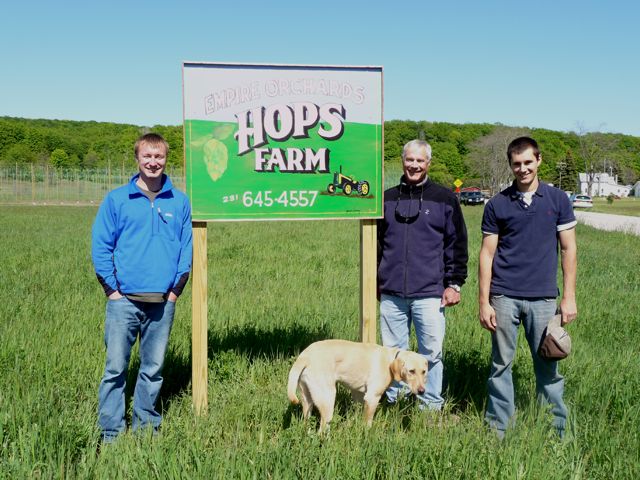
Empire Orchards’ Matt Wiesen, his father Dan Wiesen, and Zack Stanz in front of their 5-acre hops farm off M-72 and Fredrickson Rd. in Empire. Not pictured are partners John Stanz (Zack’s dad) and Mike Wiesen.
Sun contributor
It’s the world’s largest pole barn, or a wind farm, or a kiwi farm.
Those are some of the guesses made by visitors to a new hops farm on the north side of M-72, east of Fredrickson Road in Empire. With a twinkle in his eye, Dan Wiesen, one of the partners of Empire Orchards, which owns the farm, said he sometimes tells people they’re growing telephone poles on the five acres they planted this spring. Cynthia Goodrick, wife of Mike Wiesen (Dan’s brother and an Empire Orchards’ partner), said the group — which includes John Stanz and the sons of Dan, Mike and John — also has fun telling folks that it’s a grid of antennas, and they’re trying to reach aliens.
“The road has seen more traffic in the last three months than it has in the last 30 years,” Dan said with a chuckle. “There’s been quite a buzz in Empire.”
One look at the evenly-spaced, vast network of 320 twenty-foot-tall poles — with 90,000 feet of wire and a mile of crisscrossed string — and the SETI joke doesn’t seem too far-fetched. Still, Dan said a few Leelanau residents have recognized that they’re growing hops. A couple of them said they had grandparents (hailing from eastern European countries) who grew them in Suttons Bay and Empire.
Growing inspiration
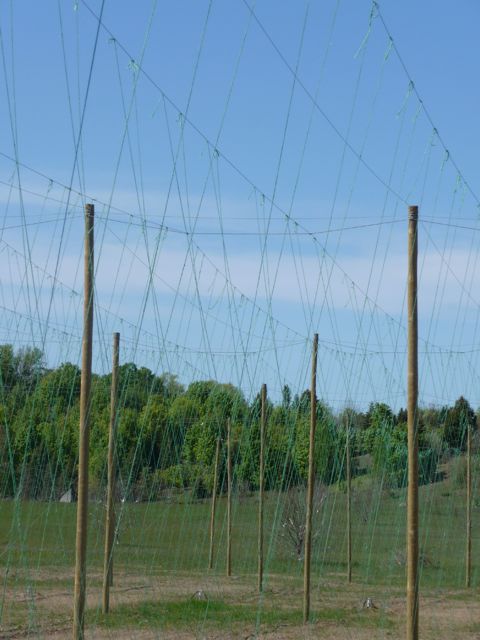
Photos by Pat Stinson
During Dan’s research, he found there was “pretty big demand” for hops in general, as a result of a Yakima, Wash. warehouse fire in October 2006, that destroyed four percent of the domestic hop harvest (two million pounds worth an estimated $3.5-$4 million). Dan explained that 80 families in Washington, Oregon and Idaho currently grow the majority of the country’s hops. Most are grown on large acreage parcels for shipment to the big breweries, according to Modern Brewery Age Weekly. In the Traverse City area, he learned that microbreweries are interested in buying locally-grown hops that are more readily available and fresher, too.
Dan said it was as if someone were tapping him on the shoulder about seizing this opportunity. He told his brother, Mike, about the crop — and Mike passed the message along to John.
When the Michigan State University (MSU) Cooperative Extension offered a workshop in December, Dan was there. The class covered the basics of getting into the business — including the start-up costs per acre ($10,000 plus) — but it was the discussion among the participants and news that the hops could be processed locally (by Old Mission Hops Exchange), that convinced him it was the right crop for John’s land. Dan and Mike each bought an interest in the property, and Empire Orchards was born.
An agricultural legacy
“The whole of Fredrickson Road, the whole of Empire was an agricultural area. As the old farmers died off, no one took over,” Dan said, emphasizing that the hops project hinged on their son’s interest in it.
According to Dan, the real enthusiasm for the new venture lies with the trio’s sons, who are in their teens and twenties. They helped plant five acres of the vining perennial (Humulus lupulus) this spring, and helped build the framework and lay 15,000 feet of irrigation pipe. One son is interested in attending brewing school in Chicago, another likes the idea of opening a microbrewery. They’re all more interested in the Internet than their dads — a good thing, since they plan to sell some of the farm’s hops online to homebrewers and others.
“We’re all in our fifties,” Dan said of his partners, “and we each have our own business. They (the sons) have a lot of new ideas and enthusiasm we don’t have.”
Dan’s son, Matt, has his own business, too: Crystal River Outfitters in Glen Arbor.
For Dan’s kids, seeing their dad as a farmer is a “new thing,” as he spent their childhood as a fine woodworker and cabinetmaker. Before that, he studied agriculture at MSU and grew fruit in New York for four years.
If the hop harvest proves successful, five new acres will be planted each year. The goal of the farm is to plant all 40 acres to hops. So far, seven total varieties of aromatic and bittering hops have been planted, including: Fuggles, Cascade, Chinook, Brewer’s Gold, Nugget, Magnum and Willamette. There’s been some discussion of growing specific varieties of barley too.
“We’re looking toward a niche market,” Dan said, “not commodities, like cherries.”
At the other end of Fredrickson, the group owns 75 acres. Here, they intend to plant at least a portion of it next year with dwarf apples (“sweet dessert apples”) and investigate other varieties (perhaps heritage — Dan’s “the man”) for future plantings.
With prices for hops at a premium last year — some retailers reported getting as much as $42 per pound for whole hops — it seems unlikely the new hops farm would falter due to market conditions. As Dan explained, the first year’s harvest is expected to be one-third to a half of mature hops, which yield 1,600-2,000 pounds of dried cones per acre. That doesn’t worry him, but Dan’s been talking to people in Washington State and knows that 7,000 new acres of hops were planted there last year — and prices peaked last year and started to fall this year.
He’s “cautiously optimistic” about their chances, though.
“Everything will be local, and I think that will be a big attraction,” he said. “We can sell roots (rhizomes) as they get older from the field to homebrewers, so they can have their own. I told Mike, ‘I think it could be a good thing.’”
Dan mentioned another idea to some of the area’s microbrewers.
Hops Festival in Empire, anyone?
Empire’s Hops History: Your help needed
Other than two reproductions of old photographs (circa 1904) in the book “Remembering Empire” — one of pickers on a hops farm and another of families with garlands of hop vines around their waists and shoulders — little seems to be known of old hop-growing ventures in the township. (Stay tuned, as we dig a little deeper for next month’s issue. Please email editorial@glenarborsun.com with any leads.)
Vines that some call “wild” and “feral,” but are probably remnants of old homesteads or hops ventures, were found at one time growing near the creek under Niagara Street, along Lake Michigan Drive, and near Mamie Johnson’s cabins between LaCore and Union streets, at least according to resident Marie Scott. She should know. Her grandfather grew hops in English Town, near Comstock Park, Mich., and stuffed dry hops in a pillow to help him sleep.