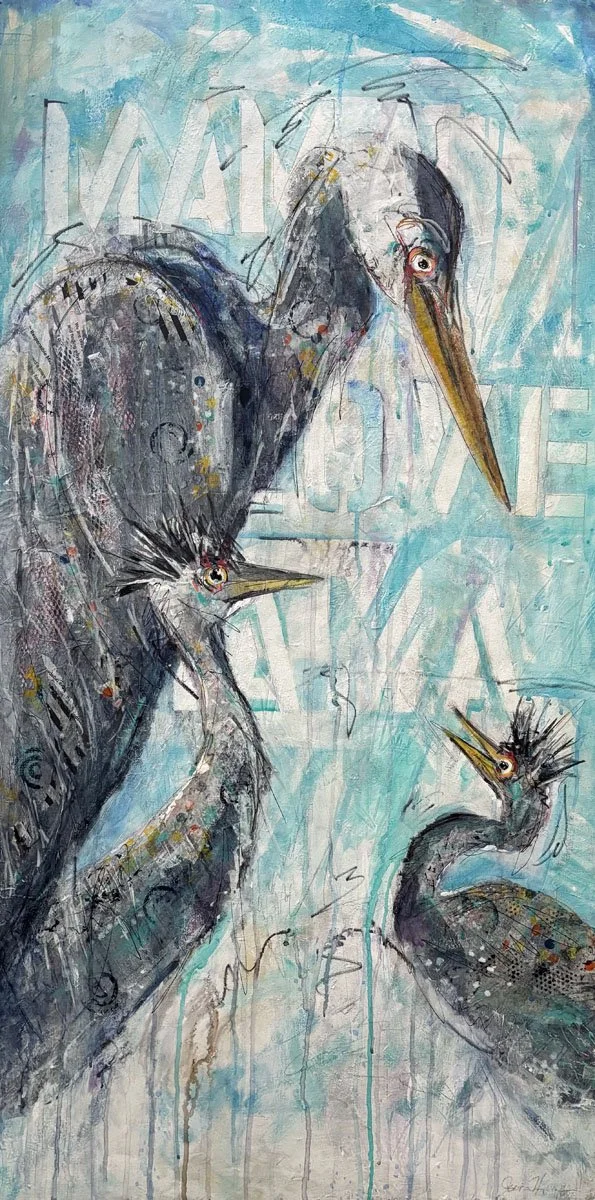
Glen Arbor Arts Center exhibit takes flight

By Katie Dunn
Sun contributor
“The large bird will take its first flight… filling the universe with amazement, filling all writings with its fame and bringing eternal glory to the nest where it was born.”
— Leonardo da Vinci (1452-1519)

Cynthia Marks
For centuries, humans have been captivated by the idea of flight—not only as a physical act, but as a symbol of possibility, freedom, and transformation. That longing to rise beyond the limits of the earth continues to stir our imagination, inviting all of us to ask: What does “taking flight” conjure?
A sudden rush of wings—like two sandhill cranes clumsily lifting off in unison over M-22 on one of my morning runs through Port Oneida.
It might be the pause at the edge of the dock on Big Glen, the water impossibly blue below before you jump in, arms wide, the thrill and nerves dissolving midair into laughter and joy.
Or it can be a leap into the unknown. A moment when apprehension gives way to action, when we choose forward motion over stillness. I often think of my own decision to make a little life for myself up here in Glen Arbor after a defining turning point—what it felt like to step into something not fully certain, but necessary all the same.
That fascination with flight has long inspired artists to look beyond the literal act of leaving the ground. One of the most profound explorations comes from Romanian sculptor Constantin Brancusi (1876-1957), whose iconic Bird in Space transformed the physical act of flight into its purest expression.
Developed in a series of sculptures spanning the 1920s through the 1940s, Brancusi was not interested in depicting a recognizable bird with wings or feathers. Instead, he sought to capture the essence of flight itself—the upward movement, the grace, the energy, the feeling of ascent. Through a simplified, elongated form polished to a luminous surface, Brancusi distilled flight into something more universal: a meditation on transcendence.
Brancusi’s vision of flight can be experienced in museums across the country, including the Metropolitan Museum of Art, the Museum of Modern Art, the Solomon R. Guggenheim Museum, the Philadelphia Museum of Art, the National Gallery of Art, the Seattle Art Museum, and the Los Angeles County Museum of Art. My personal favorite is Golden Bird at the Art Institute of Chicago—just glorious. Although it is not technically part of Brancusi’s Bird in Space series, it was a precursor to the later works, marking an important step toward his increasingly abstract vision of flight.

Michelle Tock York
While Brancusi sought to isolate flight itself, translating it into a refined and universal language, American artist Joe Overstreet (1933-2019) expanded the metaphor beyond abstraction to contemplate questions of identity and lived experience. He pushed the idea of flight into new territory, literally taking painting itself off the wall and into space.
In his Flight Pattern series of the 1970s, Overstreet suspended canvases that appear to float, stretch, and soar through the air, challenging the traditional boundaries of painting. For Overstreet, flight was not simply an image or an idea—it was an act of liberation. His dynamic, three-dimensional works engage themes of agency and the Black experience in the United States, reimagining flight as a powerful expression of possibility and resistance.
That same question of what it means to take flight lands at the Glen Arbor Arts Center (GAAC), where the current exhibition, Taking Flight, brings together artists Shanny Brooke, Cynthia Marks, and Michelle Tock York, each offering distinct interpretations of movement, becoming, and emergence.
Taking Flight represents a slightly different approach to exhibition-making at GAAC. While the concepts for GAAC exhibitions are largely developed by gallery director Sarah Bearup-Neal, Taking Flight originated with the artists themselves. “It is unusual, but not unprecedented,” Bearup-Neal says. “Shanny, Cynthia and Michelle are the brains behind this exhibit’s concept.” Her role became one of recognizing, supporting, and facilitating their vision, guiding the process behind the scenes to shape timelines, promote the exhibition, and consider how the artists’ work would come together within the gallery space.
“The work is breathtaking,” Bearup-Neal says, describing the experience of seeing mature artists who have fully mastered their materials and techniques while communicating carefully considered ideas. What distinguishes the trio, she says, is “the deeply thoughtful nature of their work.”
Ultimately, at the heart of Taking Flight are three artists whose work explores the theme through powerfully personal perspectives. Their connection began not simply as a professional collaboration, but through friendship, mutual admiration, and a shared belief in the power of art to tell stories.

Shanny Brooke
For Marks, that affinity is grounded in both discipline and a shared commitment to the creative act itself. “I would say a strong work ethic drives our connection,” she says, describing a relationship shaped by dedication as much as creative instinct. At the same time, she points to “the bond created by women through art,” noting that while their work is distinctly feminine, it is also “edgy.” What she sees as central to their relationship is intention: “None of us make simply to sell. Making is who we are.”
From that ethos came the exhibition itself. “Taking flight for all of us lent a broad swath for creating,” Marks says. “We connected with using art to tell our stories.” They work in different mediums: Brooke in oil and cold wax painting, Marks in ceramic vessels, and Tock York in mixed-media sculpture—their practices are linked by a commitment to creative expression. Brooke describes Marks and Tock York as more like family, “a lot like aunts” to her.
Within that collective vision, Tock York had a particularly important role. As Brooke puts it, Tock York was “the real driver of the show,” already envisioning what it would become. She had been heavily focused on cranes, herons and other large-winged birds, imagery that would ultimately become central to the exhibition’s visual language.
Her ambitions for Taking Flight, however, would continue without her. Tock York died in 2025 before the exhibition could come to fruition, giving the project a profound emotional dimension—not only because of her absence, but because she was the person who initiated the concept.
After Tock York received a cancer diagnosis in 2023, she adapted her process so she could continue creating. “She did not let this stop her,” Brooke explains. “She simply changed her working habits instead.”
As Bearup-Neal reflects, “Michelle Tock York had a remarkable and inventive mind. She had the rare gift of seeing the creative possibilities in cast-off objects, in bits and bobs that might otherwise be dismissed as detritus. Her work was exemplary in its execution and craftsmanship. It was always compelling. She is greatly missed for all these qualities.”
After months of imagining, planning and making, Taking Flight finally took physical form in the gallery on Aug. 21. The opening reception drew an especially vibrant response from the local arts community, with the gallery filled with visitors lingering before the work, exchanging observations and taking in the exhibition from one piece to the next.
Brooke, Marks and Tock York each approached the idea of flight through her own visual language and chosen medium, yet the works speak to one another in ways that feel both intentional and organic. The result is an exhibition that feels expansive without becoming diffuse.
Among those present at the opening reception was Wendi Peake of Glen Arbor, who saw Taking Flight as an exploration of human trajectory, more specifically “the female emotion experience as a woman, friend and mother.” She found that perspective particularly pronounced in Brooke’s work, citing paintings such as Feed Your Intuition, A Time to Let Go and The Unifier as expressions of nurturing, surrender and the instinct to hold others together. As a ceramicist herself, Peake also responded strongly to Marks’ vessels, which she described as playful yet intentionally crafted, with Empire Path offering a “mysterious container of life’s love, joy, memories and journey.” In Tock York’s work, she was struck by references to “the female form, the caged mind, the house.” Peake’s observations speak to the emotional complexity the three artists navigate.
That exploration unfolds differently in each artists’ work. For Brooke, flight became a means of expressing an inner life. She contributed 15 paintings to the exhibition, delving into the theme through a varied cast of women, horses, birds and other imagery. “My work is often about transcendence, escapism,” she says. Horses become vehicles for “a sense of freedom, a sense of letting go, breaking free,” while birds have taken on a more contemplative significance. Spending time in her garden watching and getting to know them, Brooke says, has helped her discover, as she grows older, that “slowing down, quieting my brain” can lead to what she calls a sense of “enoughness.”
Among the works is one titled Taking Flight, a particularly direct interpretation of the exhibition’s central idea: a female figure ascending, her movement suggesting both physical lift and the possibility of transcendence. Elsewhere in Brooke’s work, flight takes on a more personal dimension, becoming a way to honor her friendship with Tock York.
Two of Brooke’s paintings were created specifically with Tock York in mind: Michelle and Reverence. With Michelle, Brooke imagines her friend with wings and a crown of twigs, transforming her physical delicacy into an almost ethereal presence. It is Brooke’s portrait of the woman she knew—quiet and petite at first, but, as Brooke recalls, witty, charming and someone who “spoke when they had something to say.”
Reverence depicts a woman bowing before a heron, a subject of particular significance because Tock York had become deeply focused on sculpting herons before her death. “So, in this painting, it is me paying homage to her,” Brooke explains, “but also the shared reverence that we both had for the sacredness of nature.”
The heron becomes a point of connection between the two artists—a subject that belonged to Michelle, but was also part of a shared language through which they understood the natural world. In the gesture of the bowed figure, Brooke captures something beyond remembrance: humility before nature, gratitude for friendship and an acknowledgment of the creative bond that continues to connect them.
With Marks, Taking Flight is less about leaving the ground than about the imaginative journey that unfolds through the creative process. She creates low-fire earthenware vessels by hand, using coil and slab construction. Traditional forms are reimagined through layers of vibrant color, built through multiple firings and the use of underglazes.
Across the exhibition, her vessels vary widely in shape, scale and proportion, from diminutive, rounded forms to larger, more statuesque pieces. Their surfaces are animated by flowers, leaves and other motifs drawn from the natural world, alongside more abstract decorative patterns. “My themes come from everyday life—place, garden, art history, and travel,” she explains.
One work, A Wren in the Garden, brings those influences together in a particularly evocative form. The spherical earthenware vessel is etched with flowers and leaves, creating an intricate impression of the garden, while a small bird figure perched atop the form seems to complete the scene. It is a fitting expression of Marks’ understanding of flight—not necessarily movement through physical space, but the imaginative movement that begins in creating. “The flight occurs in our head, hand and heart when we make work,” she says.
From Marks’ vessels, Taking Flight moves into the more enigmatic territory of Tock York’s sculptural work. Though Tock York is represented by just five works—four listed as Untitled and one titled In Accordance with Nature—their presence within the exhibition is anything but slight. The works possess a quiet gravity, drawing the viewer into forms that feel at once fragile and deeply suggestive.
Bearup-Neal describes Tock York’s pieces as having “an otherworldly quality,” quickly clarifying that “not interplanetary. ‘Mythic’ would be a better adjective.” Tock York’s primarily sculptural works draw on human, animal and symbolic imagery, creating, Bearup-Neal says, “a body of work that was visually and intellectually compelling.”
One of the Untitled works is particularly arresting: a delicate female head enclosed within a structure that evokes a birdcage. The contrast is striking—the vulnerability and intricacy of the human form set against the severe geometry of its enclosure. The juxtaposition creates a tension between confinement and possibility. The viewer is left to inhabit its ambiguity, bringing personal associations and interpretations to a work that resists a singular reading.
That uncertainty feels fitting within Taking Flight. Tock York’s work does not simply depict flight; it invites us to consider what flight might mean when the human impulse to transcend the confines of the physical world is left open to interpretation. And perhaps that is where the three artists ultimately meet—not in a singular definition of flight, but in the ways their very different practices speak across mediums and experiences.
“All these pieces feel like they’re in conversation with one another,” Bearup-Neal says. “The makers of Taking Flight have cooked up a nourishing and delicious visual meal.”
Taking Flight will remain on display through Oct. 29. Visitors can explore the artists’ creative processes through GAAC’s online Creativity Q+A, available anytime, as well as hear Brooke and Marks discuss the exhibition in person at 1 p.m. on Sept. 13 at “In Conversation with Taking Flight Artists.”